Despite the amount of time I’ve expended on explaining all of these nuances of “cholesterol” numbers, I am not entirely convinced that I am healthier today because my cholesterol numbers are better. I wonder if I’m healthier today because of something else, and that whatever else is making me healthier is also correcting my cholesterol problem?
If I had to guess what is really making me healthier today, besides being less fat, I believe it is the combination of how sensitive I’ve become to insulin and how much less inflammation I have in my body, especially in and around my arteries.
If you’ve been reading my blog you’ll no doubt realize the importance of being sensitive to insulin (i.e., not being insulin resistant). Historically, insulin resistance was measured with an invasive test called a euglycemic clamp test. Basically it’s a test to measure how much insulin a person needs to keep their glucose level constant, despite the addition of glucose. The less insulin one requires, the more insulin sensitive one is.
A much simpler way to estimate insulin sensitivity is to use a test called a HOMA-IR (HOMA stands for homeostatic model assessment). The HOMA-IR is a formula that computes a number based on fasting glucose and insulin levels. Ideally, the number it computes should be 1.00. Prior to beginning any dietary intervention, my HOMA-IR was 1.38 – one sign that I was already insulin resistant. An equally obvious sign that I was insulin resistant is noted when looking at the figure below in the left-hand box.
The four-square shows the result of a test called the oral glucose tolerance test (OGTT). You show up after an overnight fast and your glucose and insulin levels are measured. (These two numbers are also required to calculate the HOMA-IR.) After your fasting glucose and insulin levels are drawn you drink a (very nasty) orange flavored glucose drink containing 75 grams of glucose. For exactly two hours you do nothing and then repeat the insulin and glucose check.
Here are my test results:
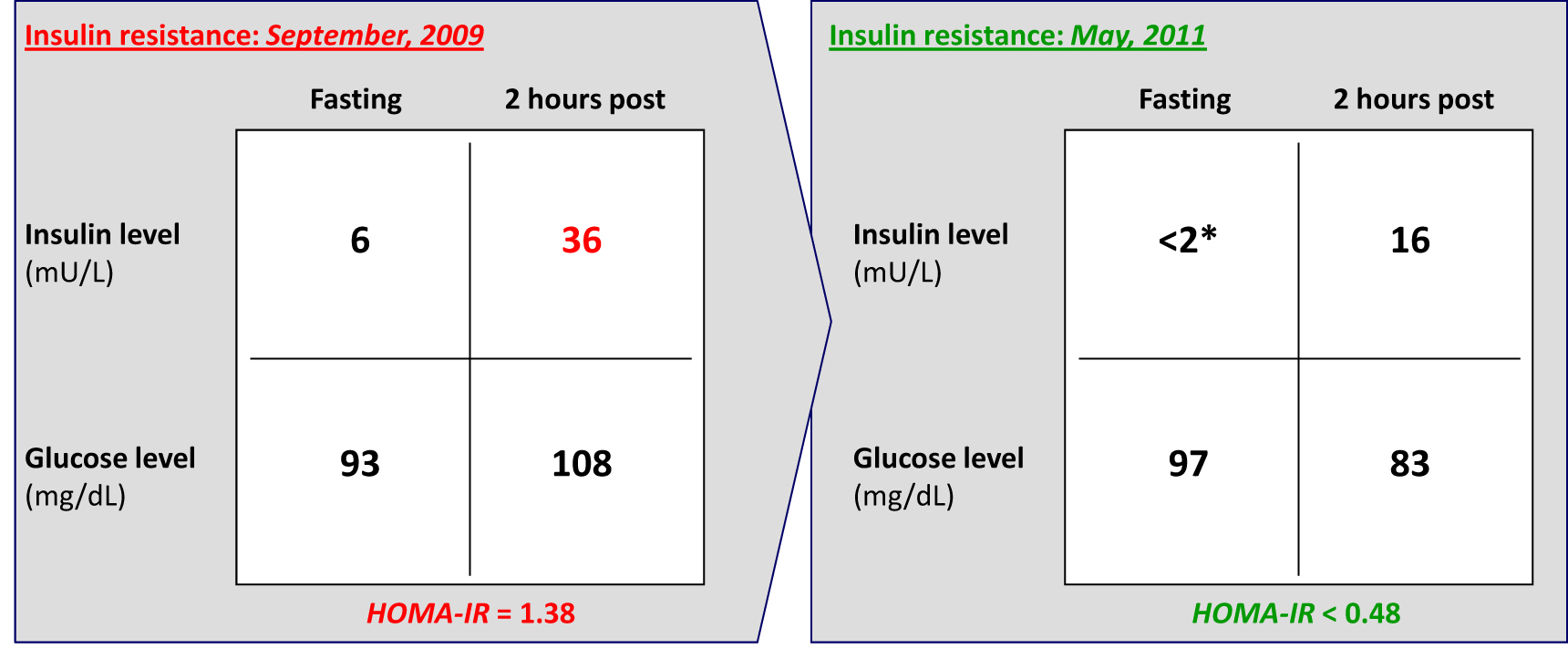
Let’s look at my test from September 2009. My fasting glucose was 93, which is normal, and my fasting insulin was 6, which was also “normal,” except that the HOMA-IR shows the combination of that glucose and insulin level are actually ill-matched. Furthermore, after 2 hours, while my glucose remained barley normal at 108, my insulin was too high, at 36, well above the upper limit of normal of 27. Hence, both by HOMA-IR and OGTT, I was clinically insulin resistant, despite never having elevated glucose levels.
I repeated the OGTT and HOMA-IR test in May 2011, just before beginning the final phase of my nutritional experiment (full-blow nutritional ketosis). By eliminating all sugar, simple carbohydrates, and reducing intake of even “good” carbs my second test was much different, as you can see on the right-hand box. On this test my fasting insulin level was undetectable (this test can’t measure insulin levels below 2, which mine was, so it simply returns a level of “less than 2”). Two hours after drinking the 75 grams of glucose, my glucose went down from 97 to 83 and my insulin “spike” was only to 16. My HOMA-IR was now less than 0.48 (I can’t say how low, because I don’t know how low my fasting insulin was). Hence, by both HOMA-IR and OGTT I had cured my insulin resistance.
Why is this so interesting? Because it actually flies in the face of conventional wisdom and “traditional” medical thinking. Most doctors (erroneously) believe that increase fat intake makes you insulin resistant. This might be true if you consume high amounts of fat in the presence of high amounts of carbohydrates (especially sugar), but when carbohydrate intake is reduced, all the fat in the world does not lead to insulin resistance.
Let me quickly summarize my findings:
- I increased the protective fraction of my HDL cholesterol
- I reduced the harmful circulating triglycerides
- I reduced the harmful fraction of my LDL cholesterol
- I reduced my insulin resistance and became very sensitive to insulin
Which of these is most important? This is an obvious and important question, but one I don’t really know the answer to (nor does anyone else, for that matter). If I had to guess, I believe observation #4 is the most important because insulin resistance is the underpinning of metabolic syndrome.
Look at the figure, below, which represents the ATP III criteria for metabolic syndrome.

At the outset I was not quite at a 40 inch waist, but I was heading there. My fasting triglyceride level was 154, so I failed on that count. My HDL was 31, so I failed on that count. Blood pressure and fasting glucose were still in check.
Two years later, I had reversed all of these symptoms of metabolic syndrome.
People have said things to me like, “Well it’s great that you’ve reduced your risk of all diseases associated with metabolic syndrome, but wouldn’t it be funny if you got hit by a car tomorrow!” All kidding aside, this misses the point. For each of us, the goal should always be to prevent the preventable.
While there is no guarantee I won’t succumb to some chronic disease (we all have to die of something at some point), the real question is, will it happen later than it would have had I not changed my eating habits? I believe, without question, that I have done – and continue to do – everything in my power to reduce my risks. And one last point – it’s not just about the number of years you live, it’s also (if not more importantly) about the quality of your life during those years.
(Part 4 of my personal journey: How a low carb diet affected my athletic performance »
