Sunday, 30 June 2013

Psoriasis is an inflammatory disease - Hyperglycemia and Psoriasis, low carb strategy

Hyperglycemia and Psoriasis | Carbohydrates Can Kill
by Robert Su, Pharm.B., M.D.
"Because psoriasis is an inflammatory disease, and hyperglycemia is inflammatory and pro-inflammatory, [11] the patients with psoriasis might have had abnormal blood glucose level or hyperglycemia before the disease starts.
At this point, psoriasis is indeed a risk factor for several serious diseases, which are related to hyperglycemia and inflammation.

Future studies are likely to show a high incidence of psoriasis in those who have hyperglycemia, even without a diagnosis of diabetes mellitus, carbohydrate restrictions will offer prevention and treatment for psoriasis and its comorbidities."
References:

1.  Zoler ML “Psoriasis Appears to Drive Up Cardiovascular Risks.” Internal Medicine News. April 15, 2011.

2.  National Psoriasis Foundation “About Psoriasis Statistics

3.  Meffert J. “Psoriasis.” Medscape. Updated on May 26, 2011.

4.  Berman K et al. “Psoriasis.” PubMed Health. Reviewed: November 8, 2010.

5.  Augustin M. et al. “Co-morbidity and Age-related Prevalence of Psoriasis: Analysis of Health Insurance Data in Germany.” ACTA Dermatovenereologica. 2010 Mar;90(2):147-51.

6.  Robert E. Burns, MD; Fred W. Whitehouse, MD  “Evidence for Impaired Glucose Tolerance in Uncomplicated Psoriasis.” Arch Dermatol. 1973;107(3):371-372.

7.  Qureshi  A. et al “Psoriasis and the risk of diabetes and hypertension – A prospective Study of US female nurses.” Archives of Dermatology. 2009 April 145(4) 379-382.

8.  Love TJ et al. “Prevalence of the Metabolic Syndrome in Psoriasis.” Arch Dermatol. 2011;147(4):419-424.

9.  Brauchli YB et al. “Psoriasis and the Risk of Incident Diabetes Mellitus: A Population-based Study.” British Journal of Dermatology. 2008;159(6):1331-1337.

10. Icen M et al. “Trends in incidence of adult-onset psoriasis over three decades: A population-based study.” Journal of the American Academy of Dermatology. Volume 60, Issue 3, Pages 394-401, March 2009.

11. Su RK “Carbohydrates Can Kill: Hyperglycemia is problematic but preventable by restricting carbohydrates. (1 of 3).” The Blog. Carbohydrates Can Kill. August 16, 2010.

How a low carb diet reduced my risk of heart disease (Part 3) « The Eating Academy | Peter Attia, M.D. The Eating Academy | Peter Attia, M.D.

How a low carb diet reduced my risk of heart disease (Part 3) « The Eating Academy | Peter Attia, M.D. The Eating Academy | Peter Attia, M.D.

Despite the amount of time I’ve expended on explaining all of these nuances of “cholesterol” numbers, I am not entirely convinced that I am healthier today because my cholesterol numbers are better.  I wonder if I’m healthier today because of something else, and that whatever else is making me healthier is also correcting my cholesterol problem?

If I had to guess what is really making me healthier today, besides being less fat, I believe it is the combination of how sensitive I’ve become to insulin and how much less inflammation I have in my body, especially in and around my arteries.

If you’ve been reading my blog you’ll no doubt realize the importance of being sensitive to insulin (i.e., not being insulin resistant).  Historically, insulin resistance was measured with an invasive test called a euglycemic clamp test. Basically it’s a test to measure how much insulin a person needs to keep their glucose level constant, despite the addition of glucose.  The less insulin one requires, the more insulin sensitive one is.

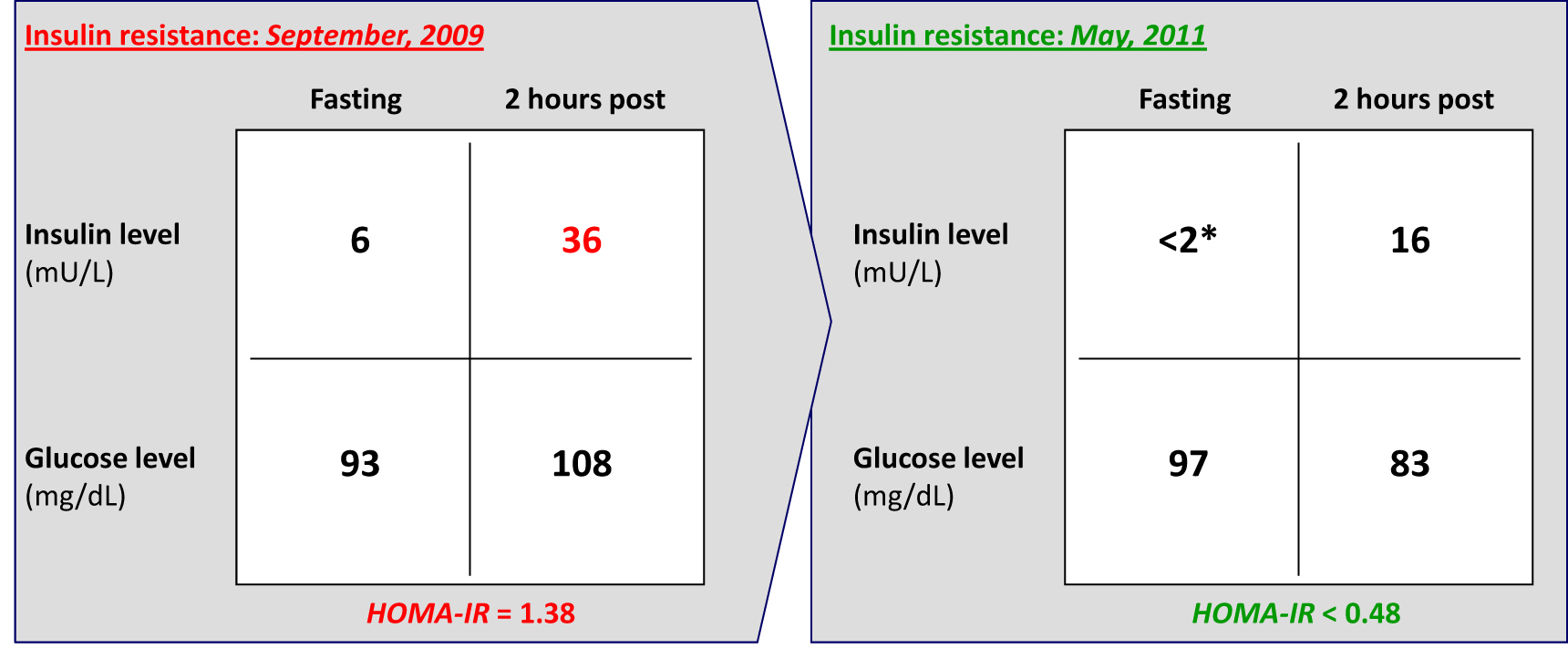
A much simpler way to estimate insulin sensitivity is to use a test called a HOMA-IR (HOMA stands for homeostatic model assessment).  The HOMA-IR is a formula that computes a number based on fasting glucose and insulin levels.  Ideally, the number it computes should be 1.00.  Prior to beginning any dietary intervention, my HOMA-IR was 1.38 – one sign that I was already insulin resistant. An equally obvious sign that I was insulin resistant is noted when looking at the figure below in the left-hand box. 

The four-square shows the result of a test called the oral glucose tolerance test (OGTT).  You show up after an overnight fast and your glucose and insulin levels are measured.  (These two numbers are also required to calculate the HOMA-IR.)  After your fasting glucose and insulin levels are drawn you drink a (very nasty) orange flavored glucose drink containing 75 grams of glucose.  For exactly two hours you do nothing and then repeat the insulin and glucose check.
Here are my test results:

Peter Attia changes in HOMA-IR and insulin sensitivity on low carb ketogenic diet chart

Let’s look at my test from September 2009.  My fasting glucose was 93, which is normal, and my fasting insulin was 6, which was also “normal,” except that the HOMA-IR shows the combination of that glucose and insulin level are actually ill-matched.  Furthermore, after 2 hours, while my glucose remained barley normal at 108, my insulin was too high, at 36, well above the upper limit of normal of 27.  Hence, both by HOMA-IR and OGTT, I was clinically insulin resistant, despite never having elevated glucose levels.

I repeated the OGTT and HOMA-IR test in May 2011, just before beginning the final phase of my nutritional experiment (full-blow nutritional ketosis).  By eliminating all sugar, simple carbohydrates, and reducing intake of even “good” carbs my second test was much different, as you can see on the right-hand box.  On this test my fasting insulin level was undetectable (this test can’t measure insulin levels below 2, which mine was, so it simply returns a level of “less than 2”).  Two hours after drinking the 75 grams of glucose, my glucose went down from 97 to 83 and my insulin “spike” was only to 16.  My HOMA-IR was now less than 0.48 (I can’t say how low, because I don’t know how low my fasting insulin was).  Hence, by both HOMA-IR and OGTT I had cured my insulin resistance.

Why is this so interesting?  Because it actually flies in the face of conventional wisdom and “traditional” medical thinking.  Most doctors (erroneously) believe that increase fat intake makes you insulin resistant.  This might be true if you consume high amounts of fat in the presence of high amounts of carbohydrates (especially sugar), but when carbohydrate intake is reduced, all the fat in the world does not lead to insulin resistance.

Let me quickly summarize my findings:
  1. I increased the protective fraction of my HDL cholesterol
  2. I reduced the harmful circulating triglycerides
  3. I reduced the harmful fraction of my LDL cholesterol
  4. I reduced my insulin resistance and became very sensitive to insulin
As I mentioned above, findings #1, 2, and 4 are almost universal in folks who abandon carbohydrates, while finding #3 is somewhat variable.

Which of these is most important?  This is an obvious and important question, but one I don’t really know the answer to (nor does anyone else, for that matter).  If I had to guess, I believe observation #4 is the most important because insulin resistance is the underpinning of metabolic syndrome.
Look at the figure, below, which represents the ATP III criteria for metabolic syndrome.

metabolic syndrome criteria

At the outset I was not quite at a 40 inch waist, but I was heading there.  My fasting triglyceride level was 154, so I failed on that count.  My HDL was 31, so I failed on that count.  Blood pressure and fasting glucose were still in check.

Two years later, I had reversed all of these symptoms of metabolic syndrome.

People have said things to me like, “Well it’s great that you’ve reduced your risk of all diseases associated with metabolic syndrome, but wouldn’t it be funny if you got hit by a car tomorrow!”  All kidding aside, this misses the point. For each of us, the goal should always be to prevent the preventable

While there is no guarantee I won’t succumb to some chronic disease (we all have to die of something at some point), the real question is, will it happen later than it would have had I not changed my eating habits?  I believe, without question, that I have done – and continue to do – everything in my power to reduce my risks.  And one last point – it’s not just about the number of years you live, it’s also (if not more importantly) about the quality of your life during those years.

(Part 4 of my personal journey: How a low carb diet affected my athletic performance »

Tuesday, 18 June 2013

Gut Flora Repair & Dr Oz - Cooling Inflammation

from: Cooling Inflammation
Monday, June 11, 2013

Where is the hippo? Trying to repair a complex community of a couple of hundred different species of bacteria by just changing diet, is like a zoo trying to add hippos by building a new enclosure and supplying it with fodder. 

You can wait and wait, but you can't add new species without adding new species. Hippos don't appear by spontaneous generation and neither does E. coli or other gut bacteria. You have to ship in hippos from other zoos and after antibiotic-induced extinction of gut bacteria, you have to introduce or eat missing species of bacteria. Also just adding probiotics will not provide a lasting fix for damaged gut flora any better than adding more elephants or giraffes will improve the diversity of a zoo lacking hippos.


I am amazed that Dr. Oz and the medical industry can encounter symptoms of dysfunctional gut flora, e.g. constipation, food intolerance, autoimmunity, allergy, that are preceded by antibiotic treatment and not address the compromised species diversity of the gut. The involvement of gut bacteria in immune system function is documented in the biomedical literature. The lasting impact of antibiotics on gut bacteria is known. Then why do Dr. Oz and the rest of the medical industry just recommend probiotics, a half dozen different species of bacteria found in fermenting dairy products (think elephants and giraffes), to repair a decimated gut bacterial community? They seem to be perplexed and ask, "Where is the hippo?"


Generalizations about Gut Bacteria
Each healthy human maintains a subset of a couple of hundred of the couple of thousand different species of bacteria found in humans around the globe. The diverse community in each individual may differ in species, but has approximately the same complement of genes in people sharing the same diet.
  • 1-200 different species of bacteria per person
  • 1-2000 different species of human gut bacteria
  • 1 million different genes among the different bacteria
  • Most genes are involved in digesting plant carbohydrates, i.e. soluble fiber, inulin, pectin, fructans, algal sulfated polysaccharides, etc.
  • Diet diversity, e.g. the Modern American Diet, reduces the diversity of the gut bacterial community, presumably because the rapid change in foods permits survival of only generalist bacteria that can digest many different foods.
  • Simple diets produce gut flora diversity, but only if there is access to diverse bacteria.
  • Health may result from diverse gut flora developed from a simplified diet and ample bacterial resources.
  • Obesity and other diseases may result from simplified gut flora developed from a changing, complex diet and a sterile environment/isolation.
  • Vegan and paleo extremes can lead to healthy gut flora diversity, if the gut bacterial community is permitted to adjust to the diet composition by avoiding rapid changes and providing diverse bacterial sources.
  • Meat contains complex polysaccharides, e.g. glycosaminoglycans, such as chondroitin sulfate and heparan sulfate proteoglycans, which are bacterial fodder equivalent to soluble fiber.
  • Probiotics are unique bacterial species that do not persist in the gut of adults, but dominate the gut of milk eating babies and stimulate development of the gut and immune system.
  • Probiotic bacteria can temporarily provide developmental signals for immune system development that are normally provided by a healthy gut flora.


Damage to Gut Flora is Not Repaired by Diet Alone
There is little or no effort being made by the medical industry to develop approaches to repair gut flora damaged by disease, unhealthy diets or medical procedures. This is similar to a surgeon stepping away from removal of a diseased organ without closing the wound. Antibiotics leave a gut flora that will remain permanently damaged without systematic, monitored repair. It might also be suspected that disruption of gut flora by antibiotics and the introduction of large amounts of new foods, such as high fructose corn syrup and vegetable oils may contribute to or cause the modern prominence of obesity. After all, gain or loss of weight changes gut flora, obese individuals have damaged gut flora, and trading gut flora between fat and lean animals, trades weight gain/loss behaviors.


Sources of Bacteria to Repair Damaged Gut Flora
  • We must eat new bacteria in order to replace bacterial species lost by antibiotics or unhealthy diets.
  • Probiotics -- specialized bacteria that grow in milk products
  • Spices and herbs -- plant products abundantly contaminated with bacteria that digest plants
  • Fresh vegetables -- bacteria are on the surfaces of plants unless the vegetables are cleaned or cooked
  • Fermented foods -- Bacterial growth leading to acid or alcohol production has beed used in the preparation and storage of many foods and provides a rich bacterial resource.
  • Environment -- Bacteria are transferred to our hands and face from other people, pets and surfaces, unless hands and the body are continually washed. Sanitizers and frequent washing of hands and surfaces eliminate acquisition of environmental bacteria to repair damaged gut flora. Social isolation and hygiene block repair of gut flora.
  • Replacement -- experimental replacement of damaged with healthy gut flora (fecal transplant) has been very effective in curing many diseases without significant risks, but is restricted by the medical industry.