A Rule of Thumb for Gut Bacteria - Wired Science
By Brandon Keim
When a bacteria has lived in human bellies for tens of thousands of years, it’s probably best to assume that it does something worthwhile.
The Economist has a story on Heliobacter pylori, a gut-dwelling microbe and longtime Wired Science favorite: nearly annihilated by modern hygiene and drugs, it causes ulcers and certain types of cancer, but may protect against other cancers, asthma and obesity.
That in itself isn’t new, but the article examines H. pylori’s complicated risks and benefits and concludes that "rather than trying to eradicate H. pylori, a better strategy would be to manage its relationship with humanity in a more sophisticated way."
A very sensible recommendation, and one we ought to apply broadly. Gut bacteria co-evolved with humanity, but haven’t yet been studied by science; H. pylori is just the beginning.
The twists and turns of fate [The Economist]
Image: Courtesy of me, proposed story art from "Hacking Your Body’s Bacteria for Better Health."
Note: A relevant factoid from my article: "In sheer numbers, bacterial cells in the body outnumber our own by a factor of 10, with 50 trillion bacteria living in the digestive system alone, where they’ve remained largely unstudied until the last decade."
Wednesday, 18 September 2013
Gut Bacteria Affect Almost Everything You Do - Wired Science

Bacteria living symbiotically inside human bodies may have an unexpectedly profound and wide ranging effect on basic biological functions such as development, reproduction and immunity.
In a comparison of blood from germ-free and regular mice, researchers found large differences in molecules that affect just about everything involved in living.
"I expected to find a couple of differences," said study co-author Bill Wikoff, a Scripps Research Institute biophysicist. "When we came back with hundreds of changes, it was a big surprise."
The human body contains 10 times more bacteria than human cells, with 50 trillion microbes living in the average digestive tract alone.
The study of these internal bacteria is in its infancy: the Human Microbiome Project, launched to catalogue our bodies’ bacterial inhabitants, started last October.
All these microbes are not just along for the ride, say scientists, but have co-evolved with human beings, providing important biochemical services in exchange for their home.
Imbalances in gut bacteria have already been linked to obesity, cancer, asthma and a host of autoimmune diseases.
Though marketers of what are known as probiotics have had some success in using bugs to treat allergies and irritable bowel disease, the causal links between bacteria and disease remain largely unspecified.
"If you want to use bacteria in an intelligent way, you really need to know what affect bacteria have on the biochemistry of a person," said Wikoff.
A critical first step in figuring them out is linking bacteria to cellular processes, known broadly as metabolites. The study of metabolites is also just getting off the ground. Some are cellular byproducts, while others are physiologically critical. But though the first draft of the human metabolome — the biochemical analogue of the human genome — was completed just two years ago, scientists know it’s important.
In the new mouse comparison study, published Monday in the Proceedings of the National Academy of Sciences, some metabolites were found only in germ-free mice. Others were found only in regular mice. Some were found in both, but in subtly different forms. The hodgepodge of results suggests that various bacteria break down, produce or otherwise tweak biochemicals.
The study "provides evidence of the profound effects of the microbiome on mammalian metabolism," said New York University microbiologist Martin Blaser. "Although the study was done in mice, the conclusions are largely generalizable to humans."
Wikoff’s team didn’t concentrate on specific metabolites, but a few stood out. Levels of the mood-regulating transmitter serotonin were altered, as were metabolites involved in processing drugs. The latter finding suggests that gut bacteria could be involved not just in maintaining health and disease, but processing drugs — helping to explain, perhaps, why drugs affect people in different ways.
Another tantalizing find in the bacteria-rich mice was indole-3 propionic acid, an antioxidant thought to have potential in treating Alzheimer’s.
As the microbiome and metabolome projects continue, the links are likely to become clearer.
"What we’ve done here is just a first step," said Wikoff.
Citation: "Metabolomics analysis reveals large effects of gut microflora on mammalian blood metabolites." By William R. Wikoff,
Andrew T. Anfor, Jun Liu, Peter G. Schultz,1, Scott A. Lesley,
Eric C. Peters, and Gary Siuzdak. Proceedings of the National Academy of Sciences, Vol. 106 No. 6, Feb. 9, 2009.
"Imbalances in gut bacteria have already been linked to obesity, cancer, asthma and a host of autoimmune diseases."
By Brandon Keim
Bacteria living symbiotically inside human bodies may have an unexpectedly profound and wide ranging effect on basic biological functions such as development, reproduction and immunity.
In a comparison of blood from germ-free and regular mice, researchers found large differences in molecules that affect just about everything involved in living.
"I expected to find a couple of differences," said study co-author Bill Wikoff, a Scripps Research Institute biophysicist. "When we came back with hundreds of changes, it was a big surprise."
The human body contains 10 times more bacteria than human cells, with 50 trillion microbes living in the average digestive tract alone.
The study of these internal bacteria is in its infancy: the Human Microbiome Project, launched to catalogue our bodies’ bacterial inhabitants, started last October.
All these microbes are not just along for the ride, say scientists, but have co-evolved with human beings, providing important biochemical services in exchange for their home.
Imbalances in gut bacteria have already been linked to obesity, cancer, asthma and a host of autoimmune diseases.
Though marketers of what are known as probiotics have had some success in using bugs to treat allergies and irritable bowel disease, the causal links between bacteria and disease remain largely unspecified.
"If you want to use bacteria in an intelligent way, you really need to know what affect bacteria have on the biochemistry of a person," said Wikoff.
A critical first step in figuring them out is linking bacteria to cellular processes, known broadly as metabolites. The study of metabolites is also just getting off the ground. Some are cellular byproducts, while others are physiologically critical. But though the first draft of the human metabolome — the biochemical analogue of the human genome — was completed just two years ago, scientists know it’s important.
In the new mouse comparison study, published Monday in the Proceedings of the National Academy of Sciences, some metabolites were found only in germ-free mice. Others were found only in regular mice. Some were found in both, but in subtly different forms. The hodgepodge of results suggests that various bacteria break down, produce or otherwise tweak biochemicals.
The study "provides evidence of the profound effects of the microbiome on mammalian metabolism," said New York University microbiologist Martin Blaser. "Although the study was done in mice, the conclusions are largely generalizable to humans."
Wikoff’s team didn’t concentrate on specific metabolites, but a few stood out. Levels of the mood-regulating transmitter serotonin were altered, as were metabolites involved in processing drugs. The latter finding suggests that gut bacteria could be involved not just in maintaining health and disease, but processing drugs — helping to explain, perhaps, why drugs affect people in different ways.
Another tantalizing find in the bacteria-rich mice was indole-3 propionic acid, an antioxidant thought to have potential in treating Alzheimer’s.
As the microbiome and metabolome projects continue, the links are likely to become clearer.
"What we’ve done here is just a first step," said Wikoff.
Citation: "Metabolomics analysis reveals large effects of gut microflora on mammalian blood metabolites." By William R. Wikoff,
Andrew T. Anfor, Jun Liu, Peter G. Schultz,1, Scott A. Lesley,
Eric C. Peters, and Gary Siuzdak. Proceedings of the National Academy of Sciences, Vol. 106 No. 6, Feb. 9, 2009.
Sardinia - An Epidemic of Auto-immune disease - Wired Science
Book Excerpt: An Epidemic of Absence - Wired Science
Today, 1 in 430 Sardinians has multiple sclerosis, a degenerative disease of the central nervous system that, as it progresses, steals one’s ability to move limbs, to see, and eventually to breathe. (That’s the official number, but Sotgiu confides that unpublished data put it higher still.) One in every 270 Sardinians has type-1 diabetes, an autoimmune condition in which the immune system attacks the body’s insulin-producing organ, the pancreas.
The stats weren’t always like this here. In Sardinia, there’s a distinct Year Zero for autoimmune disease. Just after the eradication of malaria in the 1950s, immune-mediated diseases began increasing precipitously. Sotgiu thinks the timing isn’t coincidental.
Malaria may have selected for autoimmunity-prone genes. But infection with the malaria parasite Plasmodium falciparum likely protected against the dark side of the very genes it helped shape. In this aspect, Sotgiu’s hypothesis departs from more run-of-the-mill invocations of genetics.
He suspects that the highly specialized Sardinian immune system functions properly only in the context of the invader it evolved to thwart. Sardinians need to engage with their old foe, in essence, to avoid the demons lurking within.
Today, 1 in 430 Sardinians has multiple sclerosis, a degenerative disease of the central nervous system that, as it progresses, steals one’s ability to move limbs, to see, and eventually to breathe. (That’s the official number, but Sotgiu confides that unpublished data put it higher still.) One in every 270 Sardinians has type-1 diabetes, an autoimmune condition in which the immune system attacks the body’s insulin-producing organ, the pancreas.
The stats weren’t always like this here. In Sardinia, there’s a distinct Year Zero for autoimmune disease. Just after the eradication of malaria in the 1950s, immune-mediated diseases began increasing precipitously. Sotgiu thinks the timing isn’t coincidental.
Malaria may have selected for autoimmunity-prone genes. But infection with the malaria parasite Plasmodium falciparum likely protected against the dark side of the very genes it helped shape. In this aspect, Sotgiu’s hypothesis departs from more run-of-the-mill invocations of genetics.
He suspects that the highly specialized Sardinian immune system functions properly only in the context of the invader it evolved to thwart. Sardinians need to engage with their old foe, in essence, to avoid the demons lurking within.
Inflammation & Multiple sclerosis - Wikipedia
Multiple sclerosis - Wikipedia, the free encyclopedia
Fitting with an immunological explanation, the inflammatory process is caused by T cells, a kind of lymphocyte that plays an important role in the body's defenses.[2] T cells gain entry into the brain via disruptions in the blood–brain barrier. The T cells recognize myelin as foreign and attack it, explaining why these cells are also called "autoreactive lymphocytes".[1]
The attack of myelin starts inflammatory processes which triggers other immune cells and the release of soluble factors like cytokines and antibodies. Further breakdown of the blood–brain barrier, in turn cause a number of other damaging effects such as swelling, activation of macrophages, and more activation of cytokines and other destructive proteins.[2]
Inflammation can potentially reduce transmission of information between neurons in at least three ways.[1] The soluble factors released might stop neurotransmission by intact neurons. These factors could lead to or enhance the loss of myelin, or they may cause the axon to break down completely.[1]
Multiple sclerosis (MS), also known as disseminated sclerosis or encephalomyelitis disseminata, is an inflammatory disease in which the insulating covers of nerve cells in the brain and spinal cord are damaged. This damage disrupts the ability of parts of the nervous system to communicate, resulting in a wide range of signs and symptoms,[1][2] including physical, mental,[2] and sometimes psychiatric problems.[3] MS takes several forms, with new symptoms either occurring in isolated attacks (relapsing forms) or building up over time (progressive forms).[4] Between attacks, symptoms may go away completely; however, permanent neurological problems often occur, especially as the disease advances.[4]
While the cause is not clear, the underlying mechanism is thought to be either destruction by the immune system or failure of the myelin-producing cells.[5] Proposed causes for this include genetics and environmental factors such as infections.[2][6] MS is usually diagnosed based on the presenting signs and symptoms and the results of supporting medical tests.
Multiple sclerosis
Inflammation
Apart from demyelination, the other sign of the disease is inflammation.Fitting with an immunological explanation, the inflammatory process is caused by T cells, a kind of lymphocyte that plays an important role in the body's defenses.[2] T cells gain entry into the brain via disruptions in the blood–brain barrier. The T cells recognize myelin as foreign and attack it, explaining why these cells are also called "autoreactive lymphocytes".[1]
The attack of myelin starts inflammatory processes which triggers other immune cells and the release of soluble factors like cytokines and antibodies. Further breakdown of the blood–brain barrier, in turn cause a number of other damaging effects such as swelling, activation of macrophages, and more activation of cytokines and other destructive proteins.[2]
Inflammation can potentially reduce transmission of information between neurons in at least three ways.[1] The soluble factors released might stop neurotransmission by intact neurons. These factors could lead to or enhance the loss of myelin, or they may cause the axon to break down completely.[1]
Multiple sclerosis (MS), also known as disseminated sclerosis or encephalomyelitis disseminata, is an inflammatory disease in which the insulating covers of nerve cells in the brain and spinal cord are damaged. This damage disrupts the ability of parts of the nervous system to communicate, resulting in a wide range of signs and symptoms,[1][2] including physical, mental,[2] and sometimes psychiatric problems.[3] MS takes several forms, with new symptoms either occurring in isolated attacks (relapsing forms) or building up over time (progressive forms).[4] Between attacks, symptoms may go away completely; however, permanent neurological problems often occur, especially as the disease advances.[4]
While the cause is not clear, the underlying mechanism is thought to be either destruction by the immune system or failure of the myelin-producing cells.[5] Proposed causes for this include genetics and environmental factors such as infections.[2][6] MS is usually diagnosed based on the presenting signs and symptoms and the results of supporting medical tests.
Inflammatory conditions like asthma and arthritis, eczema, psoriasis - the Hidden Costs of Modern Hygiene?
What Are the Hidden Costs of Modern Hygiene?
Chris Kresser: Sure. I can just give a brief topline summary. We’ve talked about this before in more detail when we had Moises Velasquez-Manoff, author of An Epidemic of Absence, on the show to talk about the “old friends” or hygiene hypothesis, which is the idea that we co-evolved with certain microorganisms that turn out to play a crucial role in regulating our immune system, and the disappearance of those microorganisms over the last hundred years in the industrialized world has led to a dramatic increase in chronic inflammatory disorders that can basically be separated into three categories: autoimmune disease, allergies, and then just general inflammatory conditions like asthma and arthritis, eczema, psoriasis, etc.
There’s a lot of evidence to support this hypothesis. You can look at epidemiological studies which show that the incidence of these inflammatory conditions is basically a mirror image of geographical maps of the incidence of helminth infections. Helminths are worm-like parasites that are considered to be “old friends,” meaning we evolved over a very long period of time with them, and they plan an important role in regulating our immune system. And so if you look at maps of helminth infections, they’re basically a flip-flop of maps of chronic inflammatory diseases, and the same is true when you look at levels of exposure to things like saprophytic mycobacteria, which is a kind of bacteria that are present in soil and untreated water that we’ve been exposed to throughout our entire evolutionary history but is increasingly absent in the modern environment because of changes. Essentially there is what we might call, not just a Paleolithic approach to food, but there’s a Paleolithic microbiome, and that microbiome has profound impacts on our physiology and particularly our immune system, and the shift in that microbiome may actually even be more important in some ways in terms of its effect on our health than the shift from a hunter-gatherer lifestyle to agriculture.
You may remember, Steve, when I talked about this in my presentation, what’s really interesting is there’s the theory that’s prevalent in the paleo community that the shift from a hunter-gatherer lifestyle to agriculture led to an increase in inflammatory disease and worsening in health, and there’s no doubt that there’s evidence that moving from a hunter-gatherer lifestyle to agriculture did lead to a decline in certain measures of human health, but the idea that compounds like gluten and saponins and lectins and capsaicin in peppers were responsible for this decline isn’t very well supported by the evidence because the significant increases in chronic inflammatory disease didn’t happen, really, until the last hundred years, and the change from a hunter-gatherer lifestyle to agriculture happened a full 10,000 years ago at least, maybe more like 11,000 or 12,000 years ago in certain areas. So there has to be something else that explains this because if it was true that gluten and capsaicin and lectins significantly increase the risk of inflammatory disease, it would have done that a lot longer ago than it actually did. And when you look at the evidence, one of the things that might clarify this or tie this together is it’s possible that those compounds in Neolithic foods are not a significant risk factor for inflammatory disease as long as the Paleolithic microbiome is still intact, whereas if the Paleolithic microbiome has been depleted or altered by sanitation and hygiene and other aspects of the modern lifestyle, then those foods do become risk factors for inflammatory disease.
I think actually this is probably the most important part of my whole talk, and it was a little bit buried in there. I hope it came across clearly because, for me, this has been one of the big challenges of resolving some of the apparent conflicts in this ancestral paradigm, is that if you ever talk to someone who’s well informed about anthropology and the history of human health and you say to them that grains have significantly increased the risk of inflammatory disorders, they might turn around and say: Really? Well, how did that not happen when all of these cultures were eating grains for thousands of years and those disorders were incredibly rare? Weston A. Price, for example, studied the people in the Lötschental Valley in Switzerland and the Scottish and Gaelic living in the Outer Hebrides both of whom relied on grains and dairy as staples. And then there are contemporary agricultural communities in South America and other parts of the world that really rely on tomatoes and grains and other foods that contain these Neolithic compounds, and yet autoimmune disease and asthma and things like that are really rare in those places.
We have to be able to resolve that contradiction if we want people to take us seriously when we talk about this diet, and so this “old friends” hypothesis is a way of really tying that together. And the way I would explain it to people now is by saying, look, it’s possible that if we still had the Paleolithic microbiome intact, we could tolerate grains and all of these compounds with no problem. And perhaps that explains why some people are able to tolerate those foods with apparently no problems.
But given that the microbiome has changed so significantly because of things like sanitation and hygiene and also increased use of antibiotics and decline in the consumption of fermented foods and fermentable substrates that lead to a better gut microbiome, and increased use of soaps, which actually deplete the skin from certain types of ammonia-oxidizing bacteria that we’ve evolved with for a long time, a decline in breastfeeding – because of all of that, these foods which didn’t really bother us that much for many thousands of years when our microbiome was still intact are now significant risk factors for inflammatory disease, and that’s the reason why I tend to recommend that people avoid or minimize them because we’re not living with that microbiome still intact, and there are many other aspects of the modern lifestyle that are problematic and hostile to our immune system.
So given all of that, it makes sense to me to minimize the inputs that could potentially dysregulate the system in spite of the fact that it’s theoretically possible and even epidemiologically likely that those foods are not the sole cause of an increase in inflammatory disorders.
Steve Wright: So if I understand what you just said and if I understood the talk correctly, basically the prevalence of a different gut microbiome, which your talk specifically centered in on some specific parasites, but also talked about how there was typically probably a completely different makeup because we know that that changes based on what you eat and where you live and everything, but if we focus more on this other microbiome, then it basically modulated the immune system so it made us less reactive to potential problematic foods or other things in our environment, right?
Chris Kresser: Yep. That’s pretty much it. Let’s take helminths as an example. These are the worm-like parasites that we co-evolved with for millions of years, and in fact, helminth infections first started between 564 and 528 million years ago, so we’re talking about a very, very long time. There’s evidence that not only all humans, not only all hominids, not only all mammals, but all vertebrates in the history of evolution have been exposed to helminths and infected by helminths. And if that’s true, which it certainly seems to be, based on the fossil record, then there’s actually evidence suggesting that the adaptive immune system, which is one part of our immune system that evolved in response to helminth infection, which indicates that our immune system can’t really even function as it was designed to do without helminths being present, which is kind of a mind-blowing concept, right?! That are immune system is really not normal if helminths, which are parasites, are not present, and I think that’s a difficult concept to grasp. We’re conditioned to think that parasites are harmful, and of course, some are. Some are very harmful. This is not to suggest that we have this relationship with all parasites. But helminths have been around for a long time, and our immune system is tuned to expect their presence.
What they do is they have gently suppressed inflammatory responses, and that has acted as a type of brake, if we’re going to use an analogy. Our immune system has one foot on the brake throughout most of its history, and then there are these other genetic variants that were selected for that restored inflammatory responses when helminths were present. Why would this happen? Well, let’s say you live in an area where malaria is endemic, and inflammation is the body’s way of fighting malaria off, so if you had helminths that suppress your inflammatory response, that could potentially be a disadvantage in that situation, and any genetic variants that arose that restored inflammatory responses in that situation would have been selected for. Those genetic variants were like having one foot on the accelerator, so we had one accelerator and one foot on the brake, and it kept our immune system in a type of dynamic balance.
Then all of a sudden in the last hundred years or less – because in 1947 in Europe, for example, a third of the population or more than a third still had helminths; we’re talking about a relatively recent period of time – helminths completely disappeared from the environment and from our guts, and so that foot on the brake that was providing that dynamic tension with the accelerator, so to speak, was gone, and the pedal was to the metal [indiscernible] this really dramatic epidemic of inflammatory disease because there’s nothing now that’s preventing excess inflammation that’s caused by those genetic variants.
Steve Wright: This wasn’t part of your talk, but I think it’s a question on my mind and probably others who watched your talk: How do we start to reconcile the fact that only some of us – well, it is a big enough portion of the population – are having allergies, asthma, inflammatory disorders, but nowhere near the majority yet are having those? Are do we begin to reconcile that? We know that everything has changed. The food has changed, the environment has changed, and the microbiome has changed, and there are only some of us who are extremely affected by this.
Chris Kresser: Well, actually 1 in 2 people now has allergies in the industrialized world, so that is nearly a majority, and it’s shocking when you really contemplate it. It’s 1 in 10 for autoimmune disease, and it’s tens of millions for chronic inflammatory conditions. The numbers are pretty impressive when you think about it, but nevertheless, the answer to that question, I already alluded to it. It’s a combination of genetic susceptibility, so I just talked about these genetic variants that evolved in places where other acute infections were endemic, like malaria, and they evolved as a way of protecting us from those life-threatening infections, especially when helminths were present because helminths kind of suppressed the immune response or the inflammatory response, and that’s beneficial in a certain way in that it protects us from autoimmune disease and allergies and inflammatory conditions, but it’s potentially harmful when we can get an infection like malaria and die unless we’re able to mount a sufficient inflammatory response.
There were certain areas where those genetic variants were selected for and more common. An example of this is Sardinia. Right now in Sardinia, 1 in 430 people has multiple sclerosis, and 1 in 270 has type 1 diabetes, which are extraordinarily high rates when you consider the global averages. So why are rates so high there? Well, malaria was very common in Sardinia up until it was eradicated from the island in the 1950s, and so all the people who live on Sardinia had these genes that promoted inflammation in order to help them fight off malaria infection, and as long as malaria was present at the same time, those genes didn’t lead to excess inflammation because the malaria was keeping it in check. But then when malaria was eradicated from the island in the 1950s, everyone still had those genes that promote excess inflammation, but the malaria was no longer keeping it in check, so those genes, all of a sudden, became a risk factor for autoimmune disease.
So definitely genetic predisposition is playing a big role here. Some people have these genetic variants that promote inflammation, and if they had helminths, those genetic variants wouldn’t be an issue and they wouldn’t be subject to an increased risk of autoimmune disease. And not just helminths, also the saprophytic mycobacteria and early exposure maybe even to certain viruses, like hepatitis A, and certain bacteria, like H. pylori, which is harmful later in life but may even be protective earlier in life. There are all these different aspects of the microbiome that help suppress inflammatory responses and protect against any excessive inflammation that would have been caused by these genetic variants. So that’s number one. And then number two is just exposure to other aspects of the modern lifestyle that predispose us to autoimmune disease and inflammatory conditions.
For example, if you’ve taken a lot of antibiotics when you were a kid, that had a significant impact on the microbiome, which, again, as I mentioned, shifts our susceptibility to inflammatory disease. It makes it more likely that you’ll have a leaky gut, which Dr. Fasano, who we’ve had on the show in the past, suggests is a big risk factor for autoimmune disease and may even be a precondition, which means that you can’t even develop autoimmune disease without having a leaky gut. And there’s exposure to environmental toxins. There’s exposure to food toxins. The poor-quality Western diet certainly affects the microbiome.
Basically what determines whether someone will manifest autoimmune or allergies or inflammatory disease is a combination of genetics, the status of their microbiome, and then the presence of environmental triggers, like poor diet, stress, sleep deprivation, and environmental toxins, to name a few.
Chris Kresser: Well, let me just clarify something: I think the evidence is fairly clear that early exposure to helminths while the immune system is still developing is protective, meaning people who have helminths early on in life have a lower risk of developing inflammatory disease. What’s less clear is whether inoculating yourself with helminths after inflammatory disease has already manifested or after the immune system is fully developed has the same protective effect. There’s some evidence that it can be therapeutic and even reverse some of these conditions, but as you pointed out, as I mentioned in my talk, not all evidence supports that. There have been some disappointing results.
So really, I do think actually that if we’re exposed to helminths early on in life, we have less of a risk of developing autoimmune and inflammatory disease. The question is for those of us who are adults is, does inoculating ourselves with hookworm, which is not easy or possibly even legal – There’s some gray area in terms of legality here. I mean, certainly there’s no law against somebody developing a parasite infection unintentionally or even intentionally if they want to do that to themselves, but the gray area is around people who offer that as a service and when money is changing hands and things like that. It’s being done, certainly, in the scientific community to study it, but the commercial application is a little fuzzy, shall we say?
But certainly there are other things that can be done that have already been accepted in the mainstream to help improve the microbiome, and that includes things like eating fermented foods. Fermented foods contain these kinds of bacteria that we’ve been exposed to for most of our history, and we’ve likely been eating fermented foods for a very long time because we didn’t have refrigerators until very recently, and fermentation was really one of the few ways that we could preserve food, so it’s been a part of our path.
And then there’s the idea of eating prebiotic foods or foods with a prebiotic effect, and these prebiotics essentially stimulate the growth of bacteria that are already present in our gut. Studies have shown that prebiotics actually have a more quantitative impact on the gut microbiota over time, which means that they increase the levels of healthy bacteria in the gut more than taking probiotics does. Taking probiotics tends to have more of a qualitative impact, meaning it cause dendritic cells to become anti-inflammatory, it drives the development of T regulatory cells, so essentially it helps regulate the immune system, but contrary to previous belief, studies have shown that probiotics don’t really have a significant quantitative impact over times. In other words, they don’t really “top up” depleted bacteria in the gut in the same way that prebiotics do.
There are three options for prebiotics. One is soluble fiber that has a prebiotic effect, and that’s found in certain vegetables like onions and Jerusalem artichokes and starchy tubers, other fruits and vegetables. And then resistant starch, which is harder to come by in the diet but is found in potatoes that have been cooked and cooled for around 24 hours, green bananas, green plantains, which are virtually impossible to eat raw unless you dehydrate them, which is one way to do it. You can put them in the dehydrator and make dehydrated green plantain chips. Or you can use potato starch. Richard Nikoley has written a series on resistant starch on his blog, Free the Animal, so you might want to check that out if you’re interested. He did some experimentation with it himself and had a guest blogger who has done a lot of research on it come in and talk about it, too. So those are the ways you can do it with diet. I mean, it essentially involves eating a lot of fermentable fibers, if we were going to summarize it.
Then there are supplements that you can take that are commercial prebiotics that contain things like inulin and galactooligosaccharides. Now, the caution here is that many foods with prebiotic effect, with the exception of starch, are FODMAPs, and those can be problematic in people who have gut issues like IBS or IBD, especially if they’re eaten indiscriminately. What I’ve found, which is interesting, is that even in people who are FODMAP sensitive, if their flora is really disrupted, taking a commercial prebiotic at a very low dose to start with and then maybe increasing very slowly over time can still be beneficial is though that seems somewhat contradictory because they’re really trying to avoid FODMAPs in food for the most part. Taking a little bit of things like inulin and galactooligosaccharides, if they start at a low enough dose and build up slowly, can significantly increase the gut flora, which then paradoxically can make them less sensitive to FODMAPs over time.
That’s what I’ve noticed in working with patients, and I’ve also seen that prebiotics, in general, tend to be more helpful for constipation than probiotics, with the exception of some probiotics, like Prescript-Assist and maybe Mutaflor.
Steve Wright: Awesome. Yeah, I’ve actually seen the same thing with constipation and based on your work with other people on our blog and clients that we have.
Chris Kresser: Mm-hmm.
Steve Wright: So I also have come to similar conclusions working with people that the FODMAP diet seems to work really well to alleviate symptoms, yet paradoxically, as people heal, they almost need to reverse their thoughts on the FODMAPs and begin to eat those foods again.
Chris Kresser: Sure. I mean, if they can or even just, like I said, using maybe some resistant starch, like potato starch, or some commercial prebiotics in a therapeutic way because sometimes it’s a little easier to control your dose of things like that than it is to control the exposure to prebiotic ingredients in food.
Steve Wright: Right. That’s makes sense.
Chris Kresser: Yeah.
Steve Wright: So what are you thinking about doing with Sylvie?
Chris Kresser: Sure. I can just give a brief topline summary. We’ve talked about this before in more detail when we had Moises Velasquez-Manoff, author of An Epidemic of Absence, on the show to talk about the “old friends” or hygiene hypothesis, which is the idea that we co-evolved with certain microorganisms that turn out to play a crucial role in regulating our immune system, and the disappearance of those microorganisms over the last hundred years in the industrialized world has led to a dramatic increase in chronic inflammatory disorders that can basically be separated into three categories: autoimmune disease, allergies, and then just general inflammatory conditions like asthma and arthritis, eczema, psoriasis, etc.
There’s a lot of evidence to support this hypothesis. You can look at epidemiological studies which show that the incidence of these inflammatory conditions is basically a mirror image of geographical maps of the incidence of helminth infections. Helminths are worm-like parasites that are considered to be “old friends,” meaning we evolved over a very long period of time with them, and they plan an important role in regulating our immune system. And so if you look at maps of helminth infections, they’re basically a flip-flop of maps of chronic inflammatory diseases, and the same is true when you look at levels of exposure to things like saprophytic mycobacteria, which is a kind of bacteria that are present in soil and untreated water that we’ve been exposed to throughout our entire evolutionary history but is increasingly absent in the modern environment because of changes. Essentially there is what we might call, not just a Paleolithic approach to food, but there’s a Paleolithic microbiome, and that microbiome has profound impacts on our physiology and particularly our immune system, and the shift in that microbiome may actually even be more important in some ways in terms of its effect on our health than the shift from a hunter-gatherer lifestyle to agriculture.
You may remember, Steve, when I talked about this in my presentation, what’s really interesting is there’s the theory that’s prevalent in the paleo community that the shift from a hunter-gatherer lifestyle to agriculture led to an increase in inflammatory disease and worsening in health, and there’s no doubt that there’s evidence that moving from a hunter-gatherer lifestyle to agriculture did lead to a decline in certain measures of human health, but the idea that compounds like gluten and saponins and lectins and capsaicin in peppers were responsible for this decline isn’t very well supported by the evidence because the significant increases in chronic inflammatory disease didn’t happen, really, until the last hundred years, and the change from a hunter-gatherer lifestyle to agriculture happened a full 10,000 years ago at least, maybe more like 11,000 or 12,000 years ago in certain areas. So there has to be something else that explains this because if it was true that gluten and capsaicin and lectins significantly increase the risk of inflammatory disease, it would have done that a lot longer ago than it actually did. And when you look at the evidence, one of the things that might clarify this or tie this together is it’s possible that those compounds in Neolithic foods are not a significant risk factor for inflammatory disease as long as the Paleolithic microbiome is still intact, whereas if the Paleolithic microbiome has been depleted or altered by sanitation and hygiene and other aspects of the modern lifestyle, then those foods do become risk factors for inflammatory disease.
I think actually this is probably the most important part of my whole talk, and it was a little bit buried in there. I hope it came across clearly because, for me, this has been one of the big challenges of resolving some of the apparent conflicts in this ancestral paradigm, is that if you ever talk to someone who’s well informed about anthropology and the history of human health and you say to them that grains have significantly increased the risk of inflammatory disorders, they might turn around and say: Really? Well, how did that not happen when all of these cultures were eating grains for thousands of years and those disorders were incredibly rare? Weston A. Price, for example, studied the people in the Lötschental Valley in Switzerland and the Scottish and Gaelic living in the Outer Hebrides both of whom relied on grains and dairy as staples. And then there are contemporary agricultural communities in South America and other parts of the world that really rely on tomatoes and grains and other foods that contain these Neolithic compounds, and yet autoimmune disease and asthma and things like that are really rare in those places.
We have to be able to resolve that contradiction if we want people to take us seriously when we talk about this diet, and so this “old friends” hypothesis is a way of really tying that together. And the way I would explain it to people now is by saying, look, it’s possible that if we still had the Paleolithic microbiome intact, we could tolerate grains and all of these compounds with no problem. And perhaps that explains why some people are able to tolerate those foods with apparently no problems.
But given that the microbiome has changed so significantly because of things like sanitation and hygiene and also increased use of antibiotics and decline in the consumption of fermented foods and fermentable substrates that lead to a better gut microbiome, and increased use of soaps, which actually deplete the skin from certain types of ammonia-oxidizing bacteria that we’ve evolved with for a long time, a decline in breastfeeding – because of all of that, these foods which didn’t really bother us that much for many thousands of years when our microbiome was still intact are now significant risk factors for inflammatory disease, and that’s the reason why I tend to recommend that people avoid or minimize them because we’re not living with that microbiome still intact, and there are many other aspects of the modern lifestyle that are problematic and hostile to our immune system.
So given all of that, it makes sense to me to minimize the inputs that could potentially dysregulate the system in spite of the fact that it’s theoretically possible and even epidemiologically likely that those foods are not the sole cause of an increase in inflammatory disorders.
Steve Wright: So if I understand what you just said and if I understood the talk correctly, basically the prevalence of a different gut microbiome, which your talk specifically centered in on some specific parasites, but also talked about how there was typically probably a completely different makeup because we know that that changes based on what you eat and where you live and everything, but if we focus more on this other microbiome, then it basically modulated the immune system so it made us less reactive to potential problematic foods or other things in our environment, right?
Chris Kresser: Yep. That’s pretty much it. Let’s take helminths as an example. These are the worm-like parasites that we co-evolved with for millions of years, and in fact, helminth infections first started between 564 and 528 million years ago, so we’re talking about a very, very long time. There’s evidence that not only all humans, not only all hominids, not only all mammals, but all vertebrates in the history of evolution have been exposed to helminths and infected by helminths. And if that’s true, which it certainly seems to be, based on the fossil record, then there’s actually evidence suggesting that the adaptive immune system, which is one part of our immune system that evolved in response to helminth infection, which indicates that our immune system can’t really even function as it was designed to do without helminths being present, which is kind of a mind-blowing concept, right?! That are immune system is really not normal if helminths, which are parasites, are not present, and I think that’s a difficult concept to grasp. We’re conditioned to think that parasites are harmful, and of course, some are. Some are very harmful. This is not to suggest that we have this relationship with all parasites. But helminths have been around for a long time, and our immune system is tuned to expect their presence.
What they do is they have gently suppressed inflammatory responses, and that has acted as a type of brake, if we’re going to use an analogy. Our immune system has one foot on the brake throughout most of its history, and then there are these other genetic variants that were selected for that restored inflammatory responses when helminths were present. Why would this happen? Well, let’s say you live in an area where malaria is endemic, and inflammation is the body’s way of fighting malaria off, so if you had helminths that suppress your inflammatory response, that could potentially be a disadvantage in that situation, and any genetic variants that arose that restored inflammatory responses in that situation would have been selected for. Those genetic variants were like having one foot on the accelerator, so we had one accelerator and one foot on the brake, and it kept our immune system in a type of dynamic balance.
Then all of a sudden in the last hundred years or less – because in 1947 in Europe, for example, a third of the population or more than a third still had helminths; we’re talking about a relatively recent period of time – helminths completely disappeared from the environment and from our guts, and so that foot on the brake that was providing that dynamic tension with the accelerator, so to speak, was gone, and the pedal was to the metal [indiscernible] this really dramatic epidemic of inflammatory disease because there’s nothing now that’s preventing excess inflammation that’s caused by those genetic variants.
Steve Wright: This wasn’t part of your talk, but I think it’s a question on my mind and probably others who watched your talk: How do we start to reconcile the fact that only some of us – well, it is a big enough portion of the population – are having allergies, asthma, inflammatory disorders, but nowhere near the majority yet are having those? Are do we begin to reconcile that? We know that everything has changed. The food has changed, the environment has changed, and the microbiome has changed, and there are only some of us who are extremely affected by this.
Chris Kresser: Well, actually 1 in 2 people now has allergies in the industrialized world, so that is nearly a majority, and it’s shocking when you really contemplate it. It’s 1 in 10 for autoimmune disease, and it’s tens of millions for chronic inflammatory conditions. The numbers are pretty impressive when you think about it, but nevertheless, the answer to that question, I already alluded to it. It’s a combination of genetic susceptibility, so I just talked about these genetic variants that evolved in places where other acute infections were endemic, like malaria, and they evolved as a way of protecting us from those life-threatening infections, especially when helminths were present because helminths kind of suppressed the immune response or the inflammatory response, and that’s beneficial in a certain way in that it protects us from autoimmune disease and allergies and inflammatory conditions, but it’s potentially harmful when we can get an infection like malaria and die unless we’re able to mount a sufficient inflammatory response.
There were certain areas where those genetic variants were selected for and more common. An example of this is Sardinia. Right now in Sardinia, 1 in 430 people has multiple sclerosis, and 1 in 270 has type 1 diabetes, which are extraordinarily high rates when you consider the global averages. So why are rates so high there? Well, malaria was very common in Sardinia up until it was eradicated from the island in the 1950s, and so all the people who live on Sardinia had these genes that promoted inflammation in order to help them fight off malaria infection, and as long as malaria was present at the same time, those genes didn’t lead to excess inflammation because the malaria was keeping it in check. But then when malaria was eradicated from the island in the 1950s, everyone still had those genes that promote excess inflammation, but the malaria was no longer keeping it in check, so those genes, all of a sudden, became a risk factor for autoimmune disease.
So definitely genetic predisposition is playing a big role here. Some people have these genetic variants that promote inflammation, and if they had helminths, those genetic variants wouldn’t be an issue and they wouldn’t be subject to an increased risk of autoimmune disease. And not just helminths, also the saprophytic mycobacteria and early exposure maybe even to certain viruses, like hepatitis A, and certain bacteria, like H. pylori, which is harmful later in life but may even be protective earlier in life. There are all these different aspects of the microbiome that help suppress inflammatory responses and protect against any excessive inflammation that would have been caused by these genetic variants. So that’s number one. And then number two is just exposure to other aspects of the modern lifestyle that predispose us to autoimmune disease and inflammatory conditions.
For example, if you’ve taken a lot of antibiotics when you were a kid, that had a significant impact on the microbiome, which, again, as I mentioned, shifts our susceptibility to inflammatory disease. It makes it more likely that you’ll have a leaky gut, which Dr. Fasano, who we’ve had on the show in the past, suggests is a big risk factor for autoimmune disease and may even be a precondition, which means that you can’t even develop autoimmune disease without having a leaky gut. And there’s exposure to environmental toxins. There’s exposure to food toxins. The poor-quality Western diet certainly affects the microbiome.
Basically what determines whether someone will manifest autoimmune or allergies or inflammatory disease is a combination of genetics, the status of their microbiome, and then the presence of environmental triggers, like poor diet, stress, sleep deprivation, and environmental toxins, to name a few.
Other ways to control inflammation
Steve Wright: OK, awesome. So that kind of leaves us with the question, and you’ve spoken about this before, that as you just said, H. pylori early in life seems to show a lot of benefit but late in life can be potentially carcinogenic, and you’re saying some people respond to helminth therapy and others don’t. I don’t hear you advocating for everybody getting helminths, so what are some other ways that people can take action and maybe do things to help downregulate their inflammatory response?Chris Kresser: Well, let me just clarify something: I think the evidence is fairly clear that early exposure to helminths while the immune system is still developing is protective, meaning people who have helminths early on in life have a lower risk of developing inflammatory disease. What’s less clear is whether inoculating yourself with helminths after inflammatory disease has already manifested or after the immune system is fully developed has the same protective effect. There’s some evidence that it can be therapeutic and even reverse some of these conditions, but as you pointed out, as I mentioned in my talk, not all evidence supports that. There have been some disappointing results.
So really, I do think actually that if we’re exposed to helminths early on in life, we have less of a risk of developing autoimmune and inflammatory disease. The question is for those of us who are adults is, does inoculating ourselves with hookworm, which is not easy or possibly even legal – There’s some gray area in terms of legality here. I mean, certainly there’s no law against somebody developing a parasite infection unintentionally or even intentionally if they want to do that to themselves, but the gray area is around people who offer that as a service and when money is changing hands and things like that. It’s being done, certainly, in the scientific community to study it, but the commercial application is a little fuzzy, shall we say?
But certainly there are other things that can be done that have already been accepted in the mainstream to help improve the microbiome, and that includes things like eating fermented foods. Fermented foods contain these kinds of bacteria that we’ve been exposed to for most of our history, and we’ve likely been eating fermented foods for a very long time because we didn’t have refrigerators until very recently, and fermentation was really one of the few ways that we could preserve food, so it’s been a part of our path.
And then there’s the idea of eating prebiotic foods or foods with a prebiotic effect, and these prebiotics essentially stimulate the growth of bacteria that are already present in our gut. Studies have shown that prebiotics actually have a more quantitative impact on the gut microbiota over time, which means that they increase the levels of healthy bacteria in the gut more than taking probiotics does. Taking probiotics tends to have more of a qualitative impact, meaning it cause dendritic cells to become anti-inflammatory, it drives the development of T regulatory cells, so essentially it helps regulate the immune system, but contrary to previous belief, studies have shown that probiotics don’t really have a significant quantitative impact over times. In other words, they don’t really “top up” depleted bacteria in the gut in the same way that prebiotics do.
There are three options for prebiotics. One is soluble fiber that has a prebiotic effect, and that’s found in certain vegetables like onions and Jerusalem artichokes and starchy tubers, other fruits and vegetables. And then resistant starch, which is harder to come by in the diet but is found in potatoes that have been cooked and cooled for around 24 hours, green bananas, green plantains, which are virtually impossible to eat raw unless you dehydrate them, which is one way to do it. You can put them in the dehydrator and make dehydrated green plantain chips. Or you can use potato starch. Richard Nikoley has written a series on resistant starch on his blog, Free the Animal, so you might want to check that out if you’re interested. He did some experimentation with it himself and had a guest blogger who has done a lot of research on it come in and talk about it, too. So those are the ways you can do it with diet. I mean, it essentially involves eating a lot of fermentable fibers, if we were going to summarize it.
Then there are supplements that you can take that are commercial prebiotics that contain things like inulin and galactooligosaccharides. Now, the caution here is that many foods with prebiotic effect, with the exception of starch, are FODMAPs, and those can be problematic in people who have gut issues like IBS or IBD, especially if they’re eaten indiscriminately. What I’ve found, which is interesting, is that even in people who are FODMAP sensitive, if their flora is really disrupted, taking a commercial prebiotic at a very low dose to start with and then maybe increasing very slowly over time can still be beneficial is though that seems somewhat contradictory because they’re really trying to avoid FODMAPs in food for the most part. Taking a little bit of things like inulin and galactooligosaccharides, if they start at a low enough dose and build up slowly, can significantly increase the gut flora, which then paradoxically can make them less sensitive to FODMAPs over time.
That’s what I’ve noticed in working with patients, and I’ve also seen that prebiotics, in general, tend to be more helpful for constipation than probiotics, with the exception of some probiotics, like Prescript-Assist and maybe Mutaflor.
Steve Wright: Awesome. Yeah, I’ve actually seen the same thing with constipation and based on your work with other people on our blog and clients that we have.
Chris Kresser: Mm-hmm.
Steve Wright: So I also have come to similar conclusions working with people that the FODMAP diet seems to work really well to alleviate symptoms, yet paradoxically, as people heal, they almost need to reverse their thoughts on the FODMAPs and begin to eat those foods again.
Chris Kresser: Sure. I mean, if they can or even just, like I said, using maybe some resistant starch, like potato starch, or some commercial prebiotics in a therapeutic way because sometimes it’s a little easier to control your dose of things like that than it is to control the exposure to prebiotic ingredients in food.
Steve Wright: Right. That’s makes sense.
Chris Kresser: Yeah.
Steve Wright: So what are you thinking about doing with Sylvie?
What Are the Hidden Inflamatory Disease Costs of Modern Hygiene?
What Are the Hidden Costs of Modern Hygiene?
Heather August 28, 2013 at 10:07 am
http://www.plosntds.org/article/info%3Adoi%2F10.1371%2Fjournal.pntd.0000538#s4…I don’t understand most of the article – but this part jumped out at me.
“…Helminth infection can have a broad impact on the entire immune system. Infection with trematode and nematode parasites, for example, correlates with a reduced incidence of atopic, allergic-type disorders [64]. Thus, helminth infection might potentially be useful as a novel therapy for allergic or autoimmune diseases [65]. Recently, worms, eggs, or purified nematode parasite protein have been used in preclinical and clinical trials to protect humans from allergy and autoimmunity (reviewed in [66]–[70]), including Crohn’s disease and ulcerative colitis [71],[72].
Other studies have shown that substances produced by helminths, for example Ascaris suum, Nippostrongylus brasiliensis, and Acanthocheilonema viteae, can directly interfere with allergic responses or with development of allergen-specific Th2 responses [73]–[75]. ES-62, a molecule secreted by the filarial nematode A. viteae, directly inhibits the FceRI-induced release of mediators from mast cells, protects against mast-cell–dependent hypersensitivity in skin and lungs [76] and inhibits collagen-induced arthritis [77]. Research is underway to develop molecules that mimic the activity of ES-62 as drugs for allergic and autoimmune diseases [66]. Other helminth-derived products have the potential to reduce allergic responses.
These products include schistosomal lysophosphatidylserine (lyso-PS) [61] and thioredoxin peroxidase from the liver fluke Fasciola hepatica [78]. These findings demonstrated that helminths produce products that can interfere with both the development of allergic responses and the workings of host effector mechanisms.”
Of course this research will be used to create drugs.
Heather August 28, 2013 at 10:07 am
http://www.plosntds.org/article/info%3Adoi%2F10.1371%2Fjournal.pntd.0000538#s4…I don’t understand most of the article – but this part jumped out at me.
“…Helminth infection can have a broad impact on the entire immune system. Infection with trematode and nematode parasites, for example, correlates with a reduced incidence of atopic, allergic-type disorders [64]. Thus, helminth infection might potentially be useful as a novel therapy for allergic or autoimmune diseases [65]. Recently, worms, eggs, or purified nematode parasite protein have been used in preclinical and clinical trials to protect humans from allergy and autoimmunity (reviewed in [66]–[70]), including Crohn’s disease and ulcerative colitis [71],[72].
Other studies have shown that substances produced by helminths, for example Ascaris suum, Nippostrongylus brasiliensis, and Acanthocheilonema viteae, can directly interfere with allergic responses or with development of allergen-specific Th2 responses [73]–[75]. ES-62, a molecule secreted by the filarial nematode A. viteae, directly inhibits the FceRI-induced release of mediators from mast cells, protects against mast-cell–dependent hypersensitivity in skin and lungs [76] and inhibits collagen-induced arthritis [77]. Research is underway to develop molecules that mimic the activity of ES-62 as drugs for allergic and autoimmune diseases [66]. Other helminth-derived products have the potential to reduce allergic responses.
These products include schistosomal lysophosphatidylserine (lyso-PS) [61] and thioredoxin peroxidase from the liver fluke Fasciola hepatica [78]. These findings demonstrated that helminths produce products that can interfere with both the development of allergic responses and the workings of host effector mechanisms.”
Of course this research will be used to create drugs.
Sunday, 30 June 2013
Psoriasis is an inflammatory disease - Hyperglycemia and Psoriasis, low carb strategy
Hyperglycemia and Psoriasis | Carbohydrates Can Kill
by Robert Su, Pharm.B., M.D.
1. Zoler ML “Psoriasis Appears to Drive Up Cardiovascular Risks.” Internal Medicine News. April 15, 2011.
2. National Psoriasis Foundation “About Psoriasis Statistics”
3. Meffert J. “Psoriasis.” Medscape. Updated on May 26, 2011.
4. Berman K et al. “Psoriasis.” PubMed Health. Reviewed: November 8, 2010.
5. Augustin M. et al. “Co-morbidity and Age-related Prevalence of Psoriasis: Analysis of Health Insurance Data in Germany.” ACTA Dermatovenereologica. 2010 Mar;90(2):147-51.
6. Robert E. Burns, MD; Fred W. Whitehouse, MD “Evidence for Impaired Glucose Tolerance in Uncomplicated Psoriasis.” Arch Dermatol. 1973;107(3):371-372.
7. Qureshi A. et al “Psoriasis and the risk of diabetes and hypertension – A prospective Study of US female nurses.” Archives of Dermatology. 2009 April 145(4) 379-382.
8. Love TJ et al. “Prevalence of the Metabolic Syndrome in Psoriasis.” Arch Dermatol. 2011;147(4):419-424.
9. Brauchli YB et al. “Psoriasis and the Risk of Incident Diabetes Mellitus: A Population-based Study.” British Journal of Dermatology. 2008;159(6):1331-1337.
10. Icen M et al. “Trends in incidence of adult-onset psoriasis over three decades: A population-based study.” Journal of the American Academy of Dermatology. Volume 60, Issue 3, Pages 394-401, March 2009.
11. Su RK “Carbohydrates Can Kill: Hyperglycemia is problematic but preventable by restricting carbohydrates. (1 of 3).” The Blog. Carbohydrates Can Kill. August 16, 2010.
by Robert Su, Pharm.B., M.D.
"Because psoriasis is an inflammatory disease, and hyperglycemia is inflammatory and pro-inflammatory, [11] the patients with psoriasis might have had abnormal blood glucose level or hyperglycemia before the disease starts.References:
At this point, psoriasis is indeed a risk factor for several serious diseases, which are related to hyperglycemia and inflammation.
Future studies are likely to show a high incidence of psoriasis in those who have hyperglycemia, even without a diagnosis of diabetes mellitus, carbohydrate restrictions will offer prevention and treatment for psoriasis and its comorbidities."
1. Zoler ML “Psoriasis Appears to Drive Up Cardiovascular Risks.” Internal Medicine News. April 15, 2011.
2. National Psoriasis Foundation “About Psoriasis Statistics”
3. Meffert J. “Psoriasis.” Medscape. Updated on May 26, 2011.
4. Berman K et al. “Psoriasis.” PubMed Health. Reviewed: November 8, 2010.
5. Augustin M. et al. “Co-morbidity and Age-related Prevalence of Psoriasis: Analysis of Health Insurance Data in Germany.” ACTA Dermatovenereologica. 2010 Mar;90(2):147-51.
6. Robert E. Burns, MD; Fred W. Whitehouse, MD “Evidence for Impaired Glucose Tolerance in Uncomplicated Psoriasis.” Arch Dermatol. 1973;107(3):371-372.
7. Qureshi A. et al “Psoriasis and the risk of diabetes and hypertension – A prospective Study of US female nurses.” Archives of Dermatology. 2009 April 145(4) 379-382.
8. Love TJ et al. “Prevalence of the Metabolic Syndrome in Psoriasis.” Arch Dermatol. 2011;147(4):419-424.
9. Brauchli YB et al. “Psoriasis and the Risk of Incident Diabetes Mellitus: A Population-based Study.” British Journal of Dermatology. 2008;159(6):1331-1337.
10. Icen M et al. “Trends in incidence of adult-onset psoriasis over three decades: A population-based study.” Journal of the American Academy of Dermatology. Volume 60, Issue 3, Pages 394-401, March 2009.
11. Su RK “Carbohydrates Can Kill: Hyperglycemia is problematic but preventable by restricting carbohydrates. (1 of 3).” The Blog. Carbohydrates Can Kill. August 16, 2010.
How a low carb diet reduced my risk of heart disease (Part 3) « The Eating Academy | Peter Attia, M.D. The Eating Academy | Peter Attia, M.D.
Despite the amount of time I’ve expended on explaining all of these nuances of “cholesterol” numbers, I am not entirely convinced that I am healthier today because my cholesterol numbers are better. I wonder if I’m healthier today because of something else, and that whatever else is making me healthier is also correcting my cholesterol problem?
If I had to guess what is really making me healthier today, besides being less fat, I believe it is the combination of how sensitive I’ve become to insulin and how much less inflammation I have in my body, especially in and around my arteries.
If you’ve been reading my blog you’ll no doubt realize the importance of being sensitive to insulin (i.e., not being insulin resistant). Historically, insulin resistance was measured with an invasive test called a euglycemic clamp test. Basically it’s a test to measure how much insulin a person needs to keep their glucose level constant, despite the addition of glucose. The less insulin one requires, the more insulin sensitive one is.
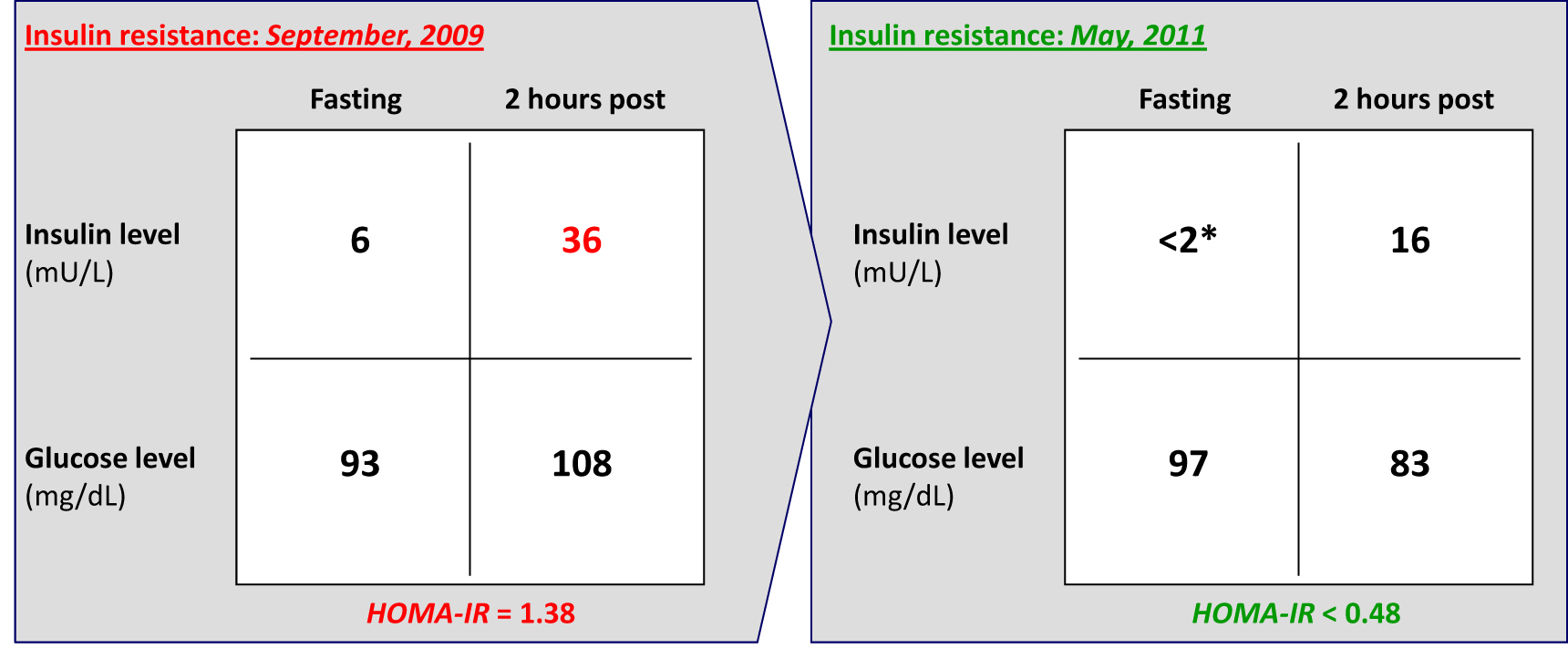
A much simpler way to estimate insulin sensitivity is to use a test called a HOMA-IR (HOMA stands for homeostatic model assessment). The HOMA-IR is a formula that computes a number based on fasting glucose and insulin levels. Ideally, the number it computes should be 1.00. Prior to beginning any dietary intervention, my HOMA-IR was 1.38 – one sign that I was already insulin resistant. An equally obvious sign that I was insulin resistant is noted when looking at the figure below in the left-hand box.
The four-square shows the result of a test called the oral glucose tolerance test (OGTT). You show up after an overnight fast and your glucose and insulin levels are measured. (These two numbers are also required to calculate the HOMA-IR.) After your fasting glucose and insulin levels are drawn you drink a (very nasty) orange flavored glucose drink containing 75 grams of glucose. For exactly two hours you do nothing and then repeat the insulin and glucose check.
Here are my test results:
Let’s look at my test from September 2009. My fasting glucose was 93, which is normal, and my fasting insulin was 6, which was also “normal,” except that the HOMA-IR shows the combination of that glucose and insulin level are actually ill-matched. Furthermore, after 2 hours, while my glucose remained barley normal at 108, my insulin was too high, at 36, well above the upper limit of normal of 27. Hence, both by HOMA-IR and OGTT, I was clinically insulin resistant, despite never having elevated glucose levels.
I repeated the OGTT and HOMA-IR test in May 2011, just before beginning the final phase of my nutritional experiment (full-blow nutritional ketosis). By eliminating all sugar, simple carbohydrates, and reducing intake of even “good” carbs my second test was much different, as you can see on the right-hand box. On this test my fasting insulin level was undetectable (this test can’t measure insulin levels below 2, which mine was, so it simply returns a level of “less than 2”). Two hours after drinking the 75 grams of glucose, my glucose went down from 97 to 83 and my insulin “spike” was only to 16. My HOMA-IR was now less than 0.48 (I can’t say how low, because I don’t know how low my fasting insulin was). Hence, by both HOMA-IR and OGTT I had cured my insulin resistance.
Why is this so interesting? Because it actually flies in the face of conventional wisdom and “traditional” medical thinking. Most doctors (erroneously) believe that increase fat intake makes you insulin resistant. This might be true if you consume high amounts of fat in the presence of high amounts of carbohydrates (especially sugar), but when carbohydrate intake is reduced, all the fat in the world does not lead to insulin resistance.
Let me quickly summarize my findings:
Which of these is most important? This is an obvious and important question, but one I don’t really know the answer to (nor does anyone else, for that matter). If I had to guess, I believe observation #4 is the most important because insulin resistance is the underpinning of metabolic syndrome.
Look at the figure, below, which represents the ATP III criteria for metabolic syndrome.
At the outset I was not quite at a 40 inch waist, but I was heading there. My fasting triglyceride level was 154, so I failed on that count. My HDL was 31, so I failed on that count. Blood pressure and fasting glucose were still in check.
Two years later, I had reversed all of these symptoms of metabolic syndrome.
People have said things to me like, “Well it’s great that you’ve reduced your risk of all diseases associated with metabolic syndrome, but wouldn’t it be funny if you got hit by a car tomorrow!” All kidding aside, this misses the point. For each of us, the goal should always be to prevent the preventable.
While there is no guarantee I won’t succumb to some chronic disease (we all have to die of something at some point), the real question is, will it happen later than it would have had I not changed my eating habits? I believe, without question, that I have done – and continue to do – everything in my power to reduce my risks. And one last point – it’s not just about the number of years you live, it’s also (if not more importantly) about the quality of your life during those years.
(Part 4 of my personal journey: How a low carb diet affected my athletic performance »
Despite the amount of time I’ve expended on explaining all of these nuances of “cholesterol” numbers, I am not entirely convinced that I am healthier today because my cholesterol numbers are better. I wonder if I’m healthier today because of something else, and that whatever else is making me healthier is also correcting my cholesterol problem?
If I had to guess what is really making me healthier today, besides being less fat, I believe it is the combination of how sensitive I’ve become to insulin and how much less inflammation I have in my body, especially in and around my arteries.
If you’ve been reading my blog you’ll no doubt realize the importance of being sensitive to insulin (i.e., not being insulin resistant). Historically, insulin resistance was measured with an invasive test called a euglycemic clamp test. Basically it’s a test to measure how much insulin a person needs to keep their glucose level constant, despite the addition of glucose. The less insulin one requires, the more insulin sensitive one is.
A much simpler way to estimate insulin sensitivity is to use a test called a HOMA-IR (HOMA stands for homeostatic model assessment). The HOMA-IR is a formula that computes a number based on fasting glucose and insulin levels. Ideally, the number it computes should be 1.00. Prior to beginning any dietary intervention, my HOMA-IR was 1.38 – one sign that I was already insulin resistant. An equally obvious sign that I was insulin resistant is noted when looking at the figure below in the left-hand box.
The four-square shows the result of a test called the oral glucose tolerance test (OGTT). You show up after an overnight fast and your glucose and insulin levels are measured. (These two numbers are also required to calculate the HOMA-IR.) After your fasting glucose and insulin levels are drawn you drink a (very nasty) orange flavored glucose drink containing 75 grams of glucose. For exactly two hours you do nothing and then repeat the insulin and glucose check.
Here are my test results:
Let’s look at my test from September 2009. My fasting glucose was 93, which is normal, and my fasting insulin was 6, which was also “normal,” except that the HOMA-IR shows the combination of that glucose and insulin level are actually ill-matched. Furthermore, after 2 hours, while my glucose remained barley normal at 108, my insulin was too high, at 36, well above the upper limit of normal of 27. Hence, both by HOMA-IR and OGTT, I was clinically insulin resistant, despite never having elevated glucose levels.
I repeated the OGTT and HOMA-IR test in May 2011, just before beginning the final phase of my nutritional experiment (full-blow nutritional ketosis). By eliminating all sugar, simple carbohydrates, and reducing intake of even “good” carbs my second test was much different, as you can see on the right-hand box. On this test my fasting insulin level was undetectable (this test can’t measure insulin levels below 2, which mine was, so it simply returns a level of “less than 2”). Two hours after drinking the 75 grams of glucose, my glucose went down from 97 to 83 and my insulin “spike” was only to 16. My HOMA-IR was now less than 0.48 (I can’t say how low, because I don’t know how low my fasting insulin was). Hence, by both HOMA-IR and OGTT I had cured my insulin resistance.
Why is this so interesting? Because it actually flies in the face of conventional wisdom and “traditional” medical thinking. Most doctors (erroneously) believe that increase fat intake makes you insulin resistant. This might be true if you consume high amounts of fat in the presence of high amounts of carbohydrates (especially sugar), but when carbohydrate intake is reduced, all the fat in the world does not lead to insulin resistance.
Let me quickly summarize my findings:
- I increased the protective fraction of my HDL cholesterol
- I reduced the harmful circulating triglycerides
- I reduced the harmful fraction of my LDL cholesterol
- I reduced my insulin resistance and became very sensitive to insulin
Which of these is most important? This is an obvious and important question, but one I don’t really know the answer to (nor does anyone else, for that matter). If I had to guess, I believe observation #4 is the most important because insulin resistance is the underpinning of metabolic syndrome.
Look at the figure, below, which represents the ATP III criteria for metabolic syndrome.
At the outset I was not quite at a 40 inch waist, but I was heading there. My fasting triglyceride level was 154, so I failed on that count. My HDL was 31, so I failed on that count. Blood pressure and fasting glucose were still in check.
Two years later, I had reversed all of these symptoms of metabolic syndrome.
People have said things to me like, “Well it’s great that you’ve reduced your risk of all diseases associated with metabolic syndrome, but wouldn’t it be funny if you got hit by a car tomorrow!” All kidding aside, this misses the point. For each of us, the goal should always be to prevent the preventable.
While there is no guarantee I won’t succumb to some chronic disease (we all have to die of something at some point), the real question is, will it happen later than it would have had I not changed my eating habits? I believe, without question, that I have done – and continue to do – everything in my power to reduce my risks. And one last point – it’s not just about the number of years you live, it’s also (if not more importantly) about the quality of your life during those years.
(Part 4 of my personal journey: How a low carb diet affected my athletic performance »
Tuesday, 18 June 2013
Gut Flora Repair & Dr Oz - Cooling Inflammation
from: Cooling Inflammation
Monday, June 11, 2013
Where is the hippo? Trying to repair a complex community of a couple of hundred different species of bacteria by just changing diet, is like a zoo trying to add hippos by building a new enclosure and supplying it with fodder.
You can wait and wait, but you can't add new species without adding new species. Hippos don't appear by spontaneous generation and neither does E. coli or other gut bacteria. You have to ship in hippos from other zoos and after antibiotic-induced extinction of gut bacteria, you have to introduce or eat missing species of bacteria. Also just adding probiotics will not provide a lasting fix for damaged gut flora any better than adding more elephants or giraffes will improve the diversity of a zoo lacking hippos.
I am amazed that Dr. Oz and the medical industry can encounter symptoms of dysfunctional gut flora, e.g. constipation, food intolerance, autoimmunity, allergy, that are preceded by antibiotic treatment and not address the compromised species diversity of the gut. The involvement of gut bacteria in immune system function is documented in the biomedical literature. The lasting impact of antibiotics on gut bacteria is known. Then why do Dr. Oz and the rest of the medical industry just recommend probiotics, a half dozen different species of bacteria found in fermenting dairy products (think elephants and giraffes), to repair a decimated gut bacterial community? They seem to be perplexed and ask, "Where is the hippo?"
Damage to Gut Flora is Not Repaired by Diet Alone
There is little or no effort being made by the medical industry to develop approaches to repair gut flora damaged by disease, unhealthy diets or medical procedures. This is similar to a surgeon stepping away from removal of a diseased organ without closing the wound. Antibiotics leave a gut flora that will remain permanently damaged without systematic, monitored repair. It might also be suspected that disruption of gut flora by antibiotics and the introduction of large amounts of new foods, such as high fructose corn syrup and vegetable oils may contribute to or cause the modern prominence of obesity. After all, gain or loss of weight changes gut flora, obese individuals have damaged gut flora, and trading gut flora between fat and lean animals, trades weight gain/loss behaviors.
Sources of Bacteria to Repair Damaged Gut Flora
You can wait and wait, but you can't add new species without adding new species. Hippos don't appear by spontaneous generation and neither does E. coli or other gut bacteria. You have to ship in hippos from other zoos and after antibiotic-induced extinction of gut bacteria, you have to introduce or eat missing species of bacteria. Also just adding probiotics will not provide a lasting fix for damaged gut flora any better than adding more elephants or giraffes will improve the diversity of a zoo lacking hippos.
I am amazed that Dr. Oz and the medical industry can encounter symptoms of dysfunctional gut flora, e.g. constipation, food intolerance, autoimmunity, allergy, that are preceded by antibiotic treatment and not address the compromised species diversity of the gut. The involvement of gut bacteria in immune system function is documented in the biomedical literature. The lasting impact of antibiotics on gut bacteria is known. Then why do Dr. Oz and the rest of the medical industry just recommend probiotics, a half dozen different species of bacteria found in fermenting dairy products (think elephants and giraffes), to repair a decimated gut bacterial community? They seem to be perplexed and ask, "Where is the hippo?"
Generalizations about Gut Bacteria
Each healthy human maintains a subset of a couple of hundred of the couple of thousand different species of bacteria found in humans around the globe. The diverse community in each individual may differ in species, but has approximately the same complement of genes in people sharing the same diet.
- 1-200 different species of bacteria per person
- 1-2000 different species of human gut bacteria
- 1 million different genes among the different bacteria
- Most genes are involved in digesting plant carbohydrates, i.e. soluble fiber, inulin, pectin, fructans, algal sulfated polysaccharides, etc.
- Diet diversity, e.g. the Modern American Diet, reduces the diversity of the gut bacterial community, presumably because the rapid change in foods permits survival of only generalist bacteria that can digest many different foods.
- Simple diets produce gut flora diversity, but only if there is access to diverse bacteria.
- Health may result from diverse gut flora developed from a simplified diet and ample bacterial resources.
- Obesity and other diseases may result from simplified gut flora developed from a changing, complex diet and a sterile environment/isolation.
- Vegan and paleo extremes can lead to healthy gut flora diversity, if the gut bacterial community is permitted to adjust to the diet composition by avoiding rapid changes and providing diverse bacterial sources.
- Meat contains complex polysaccharides, e.g. glycosaminoglycans, such as chondroitin sulfate and heparan sulfate proteoglycans, which are bacterial fodder equivalent to soluble fiber.
- Probiotics are unique bacterial species that do not persist in the gut of adults, but dominate the gut of milk eating babies and stimulate development of the gut and immune system.
- Probiotic bacteria can temporarily provide developmental signals for immune system development that are normally provided by a healthy gut flora.
Damage to Gut Flora is Not Repaired by Diet Alone
There is little or no effort being made by the medical industry to develop approaches to repair gut flora damaged by disease, unhealthy diets or medical procedures. This is similar to a surgeon stepping away from removal of a diseased organ without closing the wound. Antibiotics leave a gut flora that will remain permanently damaged without systematic, monitored repair. It might also be suspected that disruption of gut flora by antibiotics and the introduction of large amounts of new foods, such as high fructose corn syrup and vegetable oils may contribute to or cause the modern prominence of obesity. After all, gain or loss of weight changes gut flora, obese individuals have damaged gut flora, and trading gut flora between fat and lean animals, trades weight gain/loss behaviors.
Sources of Bacteria to Repair Damaged Gut Flora
- We must eat new bacteria in order to replace bacterial species lost by antibiotics or unhealthy diets.
- Probiotics -- specialized bacteria that grow in milk products
- Spices and herbs -- plant products abundantly contaminated with bacteria that digest plants
- Fresh vegetables -- bacteria are on the surfaces of plants unless the vegetables are cleaned or cooked
- Fermented foods -- Bacterial growth leading to acid or alcohol production has beed used in the preparation and storage of many foods and provides a rich bacterial resource.
- Environment -- Bacteria are transferred to our hands and face from other people, pets and surfaces, unless hands and the body are continually washed. Sanitizers and frequent washing of hands and surfaces eliminate acquisition of environmental bacteria to repair damaged gut flora. Social isolation and hygiene block repair of gut flora.
- Replacement -- experimental replacement of damaged with healthy gut flora (fecal transplant) has been very effective in curing many diseases without significant risks, but is restricted by the medical industry.
Saturday, 25 May 2013
linoleic acid (LA) causes endothelial cell activation and dysfunction which leads to atherosclerosis - Health Correlator
Health Correlator: Sudden cholesterol increase? It may be psychological:
Comments:
Studies have shown that linoleic acid (LA) causes endothelial cell activation and dysfunction which leads to atherosclerosis. LA appears to be the most pro-inflammatory fatty acid.
It has been found that membrane cholesterol can modify and inhibit linoleic acid-mediated endothelial cell dysfunction thereby protecting the vascular endothelium from oxidative stress and polyunsaturated fatty acid-mediated inflammatory responses.
http://www.ncbi.nlm.nih.gov/pubmed/?term=12701065
I recently rigged my computer to use it while standing. It is good to know that standing while using the computer may increase my cholesterol and thereby lower the risk of LA induced atherosclerosis.
May 22, 2013 at 4:21 PM"
'via Blog this'
Comments:
Studies have shown that linoleic acid (LA) causes endothelial cell activation and dysfunction which leads to atherosclerosis. LA appears to be the most pro-inflammatory fatty acid.
It has been found that membrane cholesterol can modify and inhibit linoleic acid-mediated endothelial cell dysfunction thereby protecting the vascular endothelium from oxidative stress and polyunsaturated fatty acid-mediated inflammatory responses.
http://www.ncbi.nlm.nih.gov/pubmed/?term=12701065
I recently rigged my computer to use it while standing. It is good to know that standing while using the computer may increase my cholesterol and thereby lower the risk of LA induced atherosclerosis.
May 22, 2013 at 4:21 PM"
'via Blog this'
Monday, 25 March 2013
Inflammation Shuts Down Cancer-Fighting Genes
Uploaded on 4 Jan 2012
Chronic inflammation and the chemical silencing of tumor-suppressing genes each play roles in development and progression of colorectal cancer. Research published in Nature Medicine led by MD Anderson Provost Raymond DuBois, M.D., Ph.D., connects the two factors by showing the inflammatory small molecule PGE2 silences genes via DNA methylation.
http://www.nature.com/nm/journal/vaop...
Sunday, 17 February 2013
Websites for Ray Peat Books - links
Websites for Ray Peat Books
- Email Marketing
- New car loan rates
- Trade
- Quick weight loss diet
Ray Peat
Books by Ray Peat FROM PMS TO MENOPAUSE: FEMALE HORMONES IN CONTEXT. Understanding the subject of female sexuality and health scientifically means going against the ...
Amazon.com: ray peat: Books
Each Day, a Best Seller for 75% Off or More From 9 a.m. to 1 p.m. Pacific time, December 3-14, we'll be offering a select best seller in Books at 75% or more off its ...
Amazon.com: Ray Peat: Books, Biography, Blog, Audiobooks, Kindle
Visit Amazon.com's Ray Peat Page and shop for all Ray Peat books and other Ray Peat related products (DVD, CDs, Apparel). Check out pictures, bibliography, biography ...
Ray Peat
About Ray Peat Art Gallery Links. Loading. www.RayPeat.com ... As I've discussed in my books, I see painting as an essential part of grasping the world scientifically.
Peat, Ray Books, Author Bio, Book Reviews & More at Alibris ...
Find Peat, Ray books online & save. Get this author's new, rare, signed & used books at our marketplace. Read book reviews & author bio too.
Ray Peat favorite articles and books? - PaleoHacks.com
What are your favorite Ray Peat articles and books? And/or what have you learned or applied to diet from reading Ray Peat?
Ray Peat Books
1 ~ raypeat.com: Nutrition for Women - Ray Peat 2 ~ paleohacks.com: Ray Peat favorite articles and books ? - PaleoHacks.com 3 ~ perfecthealthdiet.com
Ray Peat (Author of Mind and tissue) - Share Book ...
Ray Peat is the author of Mind and tissue (5.00 avg rating, 2 ratings, 0 reviews, published 1985)
Posts Tagged: Ray Peat books - 180 Degree Health
Articles tagged with 'Ray Peat Books' at 180 Degree Health
Dr. Raymond Peat -- Thyroid Information - Thyroid Disease ...
For more information about Dr. Ray Peat, see the ... Publications Order Page to order Ray Peat's monthly newsletter, or his books, ...
The Peat Whisperer by Danny Roddy | Ark of Wellness
In his book, The Peat Whisperer, Danny pieces together all of Ray Peat’s ideas and key concepts. He has written a clear, well-organized guide that interprets Ray ...
Dr Ray Peat on Coconut Oil - Nutiva | Organic Virgin Coconut ...
This is part one of a slightly modified version of Ray Peat’s article, which is found here. ... I thought I might write a small book on it, ...
Nutrition for women: Amazon.co.uk: Ray Peat: Books
Amazon.co.uk Trade-In Store Did you know you can trade in your old books for an Amazon.co.uk Gift Card to spend on the things you want? Visit the Books Trade-In Store ...
Your Favorite Ray Peat Article? - Peatarian Q&A
Do you have a favorite Ray Peat article? I used to have several, ... and I found an old online book containing information about them.
Peat vs. Paleo — The Danny Roddy Weblog
Ray Peat: Similar to the paleosphere, ... as your failure to secure his books proves!" Time will tell if Dr. Peat's ideas infiltrate the paleo 2.0 universe. ...
Can A Pro-Thyroid Diet Help You? A Review of Danny Roddy's ...
Dr. Ray Peat: The man, the mystery, the mangoes. What exactly is a “Peat Whisperer”? Let’s dissect the term. Danny Roddy wrote a book with that title, about a ...
Is Sunlight Through the Window Better? - Peatarian Q&A
I just received four of Ray Peat´s books. Happy :-) A lot of the stuff is in his ... outside just feels better than sitting inside behind a window.
Comfibook: Locate cell telephone information and begin to ...
Ray Peat W E L C O M E This website currently reports on my research in aging, nutrition, and hormones. You will find this information in the ARTICLES section.
Ray Peat Forum • Portal
Ray Peat Newsletter and Books Commercial Food List Ray Peat Website Articles in PDF Format Supplement List Rules, Guidelines and Medical Disclaimer Suggestions Rules
Tuesday, 12 February 2013
Ray Peat - A R T I C L E I N D E X
| |
Radiation and Growth: Incoherent imprinting from inappropriate irradiation (pdf file)
(this may take some moments to load)
LATEST ARTICLES
Sugar issues
Glucose and sucrose for diabetes
Cascara, energy, cancer and the FDA's laxative abuse
Osteoporosis, aging, tissue renewal, and product science
Regeneration and degeneration: Types of inflammation change with aging
Pathological Science & General Electric: Threatening the paradigm
Protective CO2 and aging
Genes, Carbon Dioxide and Adaptation
Serotonin, depression, and aggression: The problem of brain energy
NEWER ARTICLES
Academic authoritarians, language, metaphor, animals, and science
Adaptive substance, creative regeneration: Mainstream science, repression, and creativity
Calcium and Disease: Hypertension, organ calcification, & shock, vs. respiratory energy
Cholesterol, longevity, intelligence, and health.
Estrogen, memory and heredity: Imprinting and the stress response
Estrogen, progesterone, and cancer: Conflicts of interest in regulation and product promotion
Natural Estrogens
Tissue-bound estrogen in aging
Suitable Fats, Unsuitable Fats: Issues in Nutrition
The Great Fish Oil Experiment
Gelatin, stress, longevity
Glycemia, starch, and sugar in context
How do you know? Students, patients, and discovery
Intelligence and metabolism
Intuitive knowledge and its development
Lactate vs. CO2 in wounds, sickness, and aging; the other approach to cancer
Milk in context: allergies, ecology, and some myths
Membranes, plasma membranes, and surfaces
Multiple sclerosis, protein, fats, and progesterone
Progesterone Summaries
Progesterone Deceptions
Preventing and treating cancer with progesterone.
Protective CO2 and aging
RU486, Cancer, Estrogen, and Progesterone
Salt, energy, metabolic rate, and longevity
Stem cells, cell culture, and culture: Issues in regeneration
Thyroid, insomnia, and the insanities: Commonalities in disease
TSH, temperature, pulse rate, and other indicators in hypothyroidism
Water: swelling, tension, pain, fatigue, aging
Unsaturated fatty acids: Nutritionally essential, or toxic?
Aging, estrogen, and progesterone.
Aging Eyes, Infant Eyes, and Excitable Tissues
Altitude and Mortality.
Alzheimer's: The problem of Alzheimer's disease as a clue to immortality - part 1.
Alzheimer's: The problem of Alzheimer's disease as a clue to immortality - part 2.
Aspirin, brain and cancer.
Autonomic systems.
Bleeding, clotting, cancer.
Blocking Tissue Destruction.
Bone Density: First Do No Harm.
Breast Cancer.
BSE ("mad cow"), scrapie, etc.: Stimulated amyloid degeneration and the toxic fats.
Caffeine: A vitamin-like nutrient, or adaptogen. Questions about tea and coffee, cancer and other degenerative diseases, and the hormones.
Coconut Oil.
Diabetes, scleroderma, oils and hormones.
Eclampsia in the Real Organism: A Paradigm of General Distress Applicable in Infants, Adults, Etc.
Epilepsy and Progesterone.
Estriol, DES, DDT, etc.
Estrogen - Age Stress Hormone.
Estrogen and Osteoporosis.
Fats and degeneration.
Food-junk and some mystery ailments: Fatigue, Alzheimer's, Colitis, Immunodeficiency.
Immunodeficiency, dioxins, stress, and the hormones.
Iron's Dangers.
Leakiness, aging, and cancer.
Menopause and its causes.
Oils in Context.
Osteoporosis, harmful calcification, and nerve/muscle malfunctions.
Progesterone Pregnenolone & DHEA - Three Youth-Associated Hormones.
Progesterone, not estrogen, is the coronary protection factor of women.
Vegetables, etc.—Who Defines Food?
Thyroid: Therapies, Confusion, and Fraud.
The transparency of life: Cataracts as a model of age-related disease.
Special Topical Article: (this will take some moments to load)
Radiation and Growth: Incoherent imprinting from inappropriate irradiation (pdf file)
This website currently reports on my research in aging, nutrition, and hormones. You will find this information in the ARTICLES section.
A variety of health problems are examined (eg., infertility, epilepsy, dementia, diabetes, premenstrual syndrome, arthritis, menopause), and the therapeutic uses of progesterone, pregnenolone, thyroid, and coconut oil are frequently discussed.
My approach gives priority to environmental influences on development, regenerative processes, and an evolutionary perspective. When biophysics, biochemistry, and physiology are worked into a comprehensive view of the organism, it appears that the degenerative processes are caused by defects in our environment.
As a supplement to this web site, I've also included examples of my artwork, specifically some of my paintings, which you will find in the ART GALLERY. As I've discussed in my books, I see painting as an essential part of grasping the world scientifically. For a few years, I taught art and painted portraits. I have shown my work in both the US and Mexico.
BACKGROUND
Concerning my background, I have a Ph.D. in Biology from the University of Oregon, with specialization in physiology. The schools I have taught at include: the University of Oregon, Urbana College, Montana State University, National College of Naturopathic Medicine, Universidad Veracruzana, the Universidad Autonoma del Estado de Mexico, and Blake College. I also conduct private nutritional counseling.
I started my work with progesterone and related hormones in 1968. In papers in Physiological Chemistry and Physics (1971 and 1972) and in my dissertation (University of Oregon, 1972), I outlined my ideas regarding progesterone, and the hormones closely related to it, as protectors of the body's structure and energy against the harmful effects of estrogen, radiation, stress, and lack of oxygen.
The key idea was that energy and structure are interdependent, at every level.
Since then, I have been working on both practical and theoretical aspects of this view. I think only a new perspective on the nature of living matter will make it possible to properly take advantage of the multitude of practical and therapeutic effects of the various life-supporting substances--pregnenolone, progesterone, thyroid hormone, and coconut oil in particular.
"Marketing" of these as products, without understanding just what they do and why they do it, seems to be adding confusion, rather than understanding, as hundreds of people sell their misconceptions with their products. The very concept of "marketing" is at odds with the real nature of these materials, which has to do with the protection and expansion of our nature and potential. A distorted idea of human nature is sold when people are treated as "the market."
It seems that all of the problems of development and degeneration can be alleviated by the appropriate use of the energy-protective materials. When we realize that our human nature is problematic, we can begin to explore our best potentials.
----Ray Peat
Ray Peat, PhD Interviews – Master List – Functional Performance Systems (FPS)
Master List – Ray Peat, PhD Interviews – Functional Performance Systems (FPS)
This is the complete list of interviews with Ray Peat, PhD. Special thanks to Angela de Souza and Tyler Derosier for helping me accumulate the material. Will update as more interviews become available. Contact me if any links are fudged up or not working – Rob@functionalps.com. If you’re going to use this list on your blog, please provide citation.
FPS coaches a 12 week nutrition course based solely on the methodology of Ray Peat, PhD. Please click here for more information.
Hope for Health: Thyroid
Rainmaking Time: Life Supporting Substances
Eluv Interview: Fats
KWAI 1080 AM Interview 1 (2012)
KWAI 1080 AM Interview 2 (2012)
Politics & Science: Autoimmune and movement disorders (2012)
Politics & Science: Dogmatism in Science (2008)
Politics & Science: Origins of Life (2000)
Politics & Science: Suppression of Cancer Treatments – Dr. Ivy and Krebiozen (2001)
Politics & Science: Two Hour Fundraiser Part 1 (2012)
Politics & Science: Two Hour Fundraiser Part 2 (2012)
Politics & Science: Progesterone Part 1 (2012)
Politics & Science: Progesterone Part 2 (2012)
Politics & Science: Progesterone Part 3 (2012)
Politics & Science: Food Quality (2012)
Politics & Science: A Self Ordering World
Politics & Science: Fats
Politics & Science: Ionizing Radiation in Context, Parts 1 & 2
Politics & Science: Nuclear Disaster
Politics & Science: Obfuscation of Radiation Science by Industry
Politics & Science: Thyroid and Regeneration
Politics & Science: Machinist Scientist
Herb Doctors: Carbon Monoxide (NEW 2013)
Herb Doctors: Learning, Dementia, Alzheimers (2012)
Herb Doctors: Ionizing and Non-Ionizing Radiation (2012)
Herb Doctors: Inorganic Phosphates, Calcium:Phosphorus Ratio, & Aging (2012)
Herb Doctors: Blood Pressure Regulation Heart Failure and Muscle Atrophy (2012)
Herb Doctors: Cellular Repair (2012)
Herb Doctors: Genetic Determinism (2012)
Herb Doctors: Alkalinity vs Acidity (2012)
Herb Doctors: Cancer Treatment (2012)
Herb Doctors: Sodium/Salt, Inflammation, Pregnancy Toxemia, Water Retention
Herb Doctors: Energy Production, Diabetes, and Saturated Fats
Herb Doctors: Sugar II
Herb Doctors: Sugar I, Cholesterol, Obesity, Heart Disease
Herb Doctors: Endotoxins
Herb Doctors: Hair loss, Osteoporosis
Herb Doctors: Inflammation
Herb Doctors: Milk
Herb Doctors: Radiation
Herb Doctors: Serotonin, Endotoxins, and Stress
Herb Doctors: Altitude
Herb Doctors: Sugar Part 1
Herb Doctors: Sugar Part 2
Herb Doctors: Fukujima I
Herb Doctors: Fukujima II, Serotonin, & Melatonin
Herb Doctors: Hormones, Metabolism
Herb Doctors: Misconceptions about Serotonin and Melatonin
World Puja: Foundational Hormones
East West – Q&A Show 2
East West – Cholesterol and Saturated Fat
East West – Serotonin and Endotoxin
East West – Q&A Show
East West – Milk, Calcium, Hormones
East West – Glycemia, Starch, Sugar
East West – Estrogen, Progesterone
East West – Thyroid
East West – Inflammation
East West – Dangers of PUFA
The following are courtesy of Bud Weiss:
Bud Weiss Sept. 2008
Bud Weiss Audio Biology of Carbon Dioxide Oct. 2010
Bud Weiss Video Biology of Carbon Dioxide Oct. 2010
Also see:
Collection of Ray Peat Quote Blogs by FPS
Posted in General.
Tagged with carbon dioxide, co2, endotoxin, estrogen, facebook, FPS, Functional Performance Systems, functionalps, histamine, Interview, interviews, master list, progesterone, PUFA, Ray Peat, ray peat interviews, saturated fats, serotonin, thyroid.
16 comments
By Team FPS – September 12, 2011
Subscribe to:
Comments (Atom)